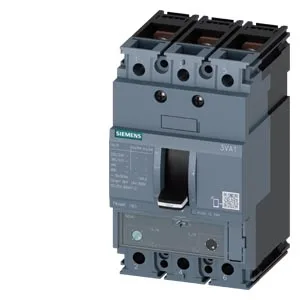
What this MCCB delivers on the line
The Siemens SENTRON 3VA1180-3EF32-0DH0 is a 3-pole molded case circuit breaker rated for 80 A continuous current, with a TM240 thermal-magnetic overcurrent release. It's built for line protection — the kind of duty where you need a rugged breaker that holds up under sustained load and clears faults fast. The interrupting ratings tell the story: 75.6 kA at 240 V, 52.5 kA at 415 V, 32 kA at 440 V, and 10.5 kA at 690 V. That 75.6 kA at 240 V means it handles serious fault current on a 240 V distribution bus without the breaker welding shut or the arc flashing upstream — a key spec for high-available-fault-current panels. The TM240 release is a thermal-magnetic design: thermal bimetal for overload protection (inverse time curve), magnetic coil for short-circuit instant trip. No electronic adjustments, no communications module — this is a straight-ahead breaker for fixed-line protection where you don't need remote monitoring or adjustable trip settings. It includes an undervoltage release (UVR) that trips the breaker when supply voltage drops below a threshold, protecting motors or other voltage-sensitive loads from brownout conditions.
Thermal derating — what it can really carry
This breaker holds its full 80 A rating from 40 °C up to 50 °C ambient. At 55 °C it derates to 76.8 A, at 60 °C to 75.2 A, at 65 °C to 73.6 A, and at 70 °C to 72 A. If your panel runs hot — say inside a sealed enclosure near a motor drive — you need to account for that drop. The 80 A continuous rating is at 40 °C ambient; above that, the thermal element responds faster and the breaker may nuisance-trip if you load it to the nameplate. For a 70 °C panel environment, plan for a 72 A load limit.
Panel fit and auxiliaries
The breaker measures 130 mm high, 76.2 mm wide, and 70 mm deep. That's a standard SENTRON 3VA frame footprint — it fits existing 3VA panel cutouts and busbar arrangements without re-drilling. The front face carries IP40 protection, so it's fine in a clean indoor panel but not for washdown or outdoor exposure. An auxiliary contact block is integrated: 2 auxiliary switches plus 1 trip alarm switch (HQ type), giving you status feedback for PLC or indicator lamps. The trip indicator is present — a visible flag when the breaker has tripped on fault, not just manually switched off.
