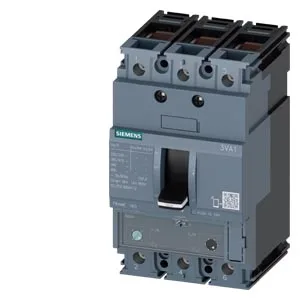
The Siemens 3VA1180-5EF36-0AF0 is a SENTRON molded case circuit breaker built for line protection — 3-pole, rated 80 A continuous at 40 °C, with a TM240 thermal-magnetic release that handles overloads and short-circuits in one package. At 240 V it interrupts up to 187 kA, which gives serious fault-current headroom for a panel fed close to a large transformer. The interrupting rating drops to 121 kA at 415 V, 75.6 kA at 440 V, and 17 kA at 500 V or 690 V — still solid numbers for most industrial service entrances.
Above that it derates gradually: 78 A at 55 °C, 77 A at 60 °C, 75 A at 65 °C, 74 A at 70 °C. That's predictable and easy to factor into the load calculation. Footprint is 130 mm tall, 76.2 mm wide, 70 mm deep — standard 3-pole MCCB envelope that drops onto a DIN rail or direct-mount plate. The 76.2 mm width (3 inches) is the same as most SENTRON 3VA1 frames, so swapping into an existing panel with a different 3VA1 variant usually lines up with the bus bars and lug kit. That's moderate for an 80 A frame — the heat stays manageable inside a ventilated enclosure, but worth noting for a sealed stainless panel where every watt adds to the cooling budget.
Built-in auxiliary and alarm switching
That gives remote status on both the breaker position and whether it tripped on fault — useful for a PLC input or a remote annunciator panel without adding a separate accessory module.