Breaking capacity across voltages
The 3VA1180-5EF36-0KC0: This MCCB delivers 121 kA at 415 VAC and 75.6 kA at 440 VAC, then drops to 17 kA at 500 V and 690 V. That steep roll-off above 440 V means the interrupting rating at 480/500 V systems is a tenth of the 240 V figure — the 17 kA at 500 V still clears most industrial fault levels, but you verify the available fault current at the point of installation before committing the BOM line.
Built-in auxiliary and release options
The shunt trip allows remote tripping from a safety relay or emergency-stop circuit — useful for a burner management system or turbine protection logic where you need a hard-wired trip path independent of the controller. There is no undervoltage release fitted on this variant, and no ground-fault monitoring module. The voltage trigger is present, meaning the shunt trip coil is wired for a specific control voltage; confirm the coil rating against your 24 VDC or 110 VAC control supply before panel integration.
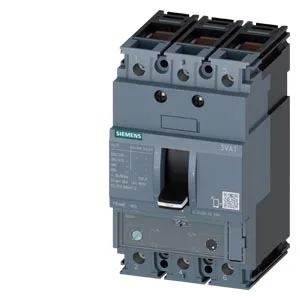
The 3VA1180-5EF36-0KC0 measures 130 mm high, 76.2 mm wide, and 70 mm deep — a 3-pole MCCB footprint that fits standard Siemens SENTRON mounting bases and busbar systems. Panel builders working to a 200 mm deep enclosure will have room for the breaker plus rear-connected busbars. The maximum power loss is 19.2 W, so ventilation slots or a small fan are advisable if multiple breakers are ganged in a sealed cabinet.
Environmental limits and storage
The storage maximum of 80 °C governs handling during shipping or warehouse storage in hot climates — the breaker can sit in a non-climate-controlled container, provided it is not energized above 70 °C. The -40 °C storage floor is standard for cold-chain or outdoor substation spares.