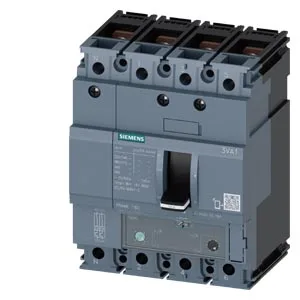
The interrupting capacity tells you what it can safely clear: 187 kA at 240 V, 121 kA at 415 V, 75.6 kA at 440 V, and 17 kA at both 500 V and 690 V. That kind of muscle means it'll handle a hard fault on a big motor feeder or a main panel without welding its contacts shut. The 80 A rating holds steady from 40 °C up through 50 °C, then starts a gentle taper: 78 A at 55 °C, 77 A at 60 °C, 75 A at 65 °C, and 74 A at 70 °C. Power loss maxes out at 19.2 W, so it's not a heat bomb in the enclosure.
That's a four-inch width on the panel face, so it takes up a standard MCCB slot. It's designed for screw-mounting on a backplate or DIN rail adapter; no communication module inside, so it's a straight power path. The N-conductor protection is rated at 100%, meaning the neutral pole is fully rated, not a reduced cross-section. There's no ground-fault monitoring built in — if you need that, you'll add an external module. The design accepts an optional motor drive (Product Extension / Optional / Motor Drive: Yes), so you can motorize it for remote tripping or reclosing if the application calls for it. That covers most plant-floor conditions — unheated warehouses in winter, hot mezzanines in summer.