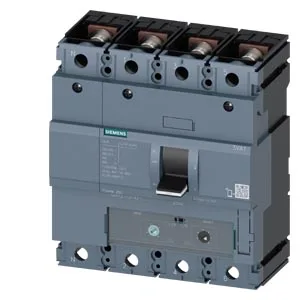
MCCB for line protection — 200 A, 4-pole, TM240 release
Breaking capacity reaches 121 kA at 240 V and 75.6 kA at 415 V, so it handles high-fault-current scenarios common in industrial mains or sub-distribution boards without cascading upstream.
Breaking capacity across voltages — selectivity planning
The interrupting ratings step down predictably with voltage: 121 kA at 240 V, 75.6 kA at 415 V, 52.5 kA at 440 V, 17 kA at 500 V, and 11.9 kA at 690 V. For a 415 V system — common in European industrial panels — the 75.6 kA SCCR gives substantial headroom above typical 25–50 kA fault levels, simplifying coordination with downstream breakers.
Thermal derating — continuous current vs. ambient temperature
Above that, derate linearly: 194 A at 55 °C, 188 A at 60 °C, 182 A at 65 °C, and 176 A at 70 °C. Factor this into the load calculation; the TM240 release does not compensate for ambient drift.
Physical fit and auxiliary switching
Dimensions are 140 mm wide, 158 mm high, 70 mm deep — a 4-pole MCCB that fits standard Siemens SENTRON mounting patterns. Insulation voltage rated at 800 V, operating temperature range -25 °C to 70 °C, storage from -40 °C to 80 °C. Maximum power loss is 42 W at rated current — account for this in enclosure thermal calculations.