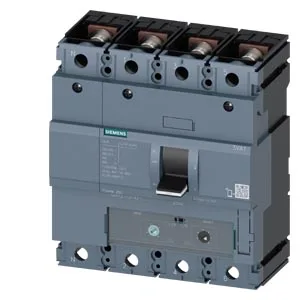
What this MCCB carries and what it means for your panel
The Siemens SENTRON 3VA1220-5GF42-0HH0 is a 4-pole molded case circuit breaker (MCCB) rated for line-protection duty at a continuous current Iu of 200 A. The interrupting ratings climb to 187 kA at 240 V AC, 121 kA at 415 V, 36 kA at 440 V, and 17 kA at 690 V — figures that tell you this breaker can sit at the main or a high-fault subfeed without needing an upstream current-limiting fuse. The thermal-magnetic release is a TM240, so the thermal pickup is fixed and the magnetic trip threshold is set at the factory; no field-adjustable electronic curves here. That matters when you are coordinating with downstream breakers: you need to know the TM240's band, not guess at a dial setting. The 200 A rating holds flat from 40 °C through 50 °C ambient, then derates to 194 A at 55 °C, 188 A at 60 °C, 182 A at 65 °C, and 176 A at 70 °C. If your panel hits 55 °C near the breaker — common in a tightly packed enclosure with a transformer nearby — you lose 6 A of headroom. Plan the continuous load at 80 % of the derated value and you stay inside the thermal curve. The auxiliary contact block ships as 2 auxiliary switches plus 1 trip alarm switch (HQ variant), and a shunt trip (STL) is integrated — order code 3VA9688-0BL30 for the release coil itself. No undervoltage release, no communication module, no phase-failure detection on this variant. It is a straight-ahead line-protection breaker with a remote-trip capability and a separate alarm contact for the maintenance PLC.
Panel fit and mounting
Footprint: 140 mm wide, 158 mm tall, 70 mm deep. The 70 mm depth is the body only; add clearance for the arc-chamber exhaust and the shunt-trip wiring channel. IP40 on the front means it is protected against tools and wires >1 mm — standard for a dead-front switchboard, but not for washdown zones. Mount it on the DIN rail or bolt it to the backplate; the SENTRON family uses the same lug centres as the 3VA1 frame, so a panel laid out for a 3VA1110 will accept this 200 A frame without re-drilling the mounting holes.
