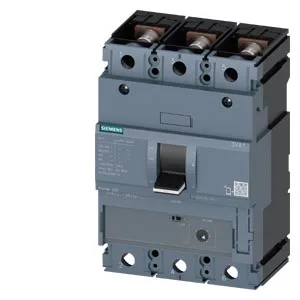
Rated for a continuous 200 A at 40 °C through 50 °C, it holds that current flat across the typical panel ambient range — only starts derating above 55 °C, dropping to 180 A at 70 °C. That thermal curve matters if you're packing this into a hot enclosure or a non-ventilated section of the panel. Breaking capacity is the headline here: 187 kA at 240 V AC, 121 kA at 415 V, 30 kA at 440 V, and 17 kA at 690 V. No electronic trip unit here, so no adjustable curves or communication. The integrated undervoltage release (UVR) is built in, part of the base design, not an add-on. That UVR will drop the breaker if control voltage is lost, which is standard for emergency-stop or safety-related disconnect circuits.
Panel footprint: 105 mm wide, 158 mm high, 70 mm deep. No auxiliary contacts are included (the auxiliary contact version is listed as 'Without'), so if you need status feedback to a PLC, you'll need to add the separate auxiliary trip accessory 3VA9608-0BB24. The IP40 front protection means it's fine for a closed panel; don't mount it where washdown or dripping water hits the front face. The starter protection designation means the thermal-magnetic release is calibrated for motor-starting duty — higher magnetic pickup to avoid tripping on inrush, and a thermal curve that matches motor heating characteristics. At AC-3 duty (400 V) it's rated for 75 W of switching power, which covers most direct-on-line motor starters up to about 37 kW depending on the motor's full-load amps. No phase failure detection built in, so if single-phasing is a concern on your line, you'll need a separate phase-loss relay or a motor protection relay downstream.