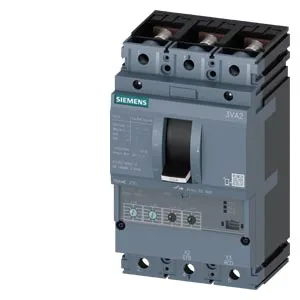
MCCB for high-fault panels — what the ratings mean
The Siemens SENTRON 3VA2225-6HN32-0HC0 is a 3-pole molded case circuit breaker rated for 250 A continuous at 40 °C, with an interrupting capacity of 242 kA at 240 V — that's the fault current it can safely clear without welding contacts or rupturing the case, which matters when you're protecting a transformer secondary or a bus tie in a high-fault panel. At 415 V and 440 V the interrupting rating drops to 187 kA, and at 690 V it's 4.5 kA — still enough for most industrial distribution, but worth checking if your fault study shows a higher number at the line side.
Rated 250 A at 40 °C ambient, the breaker holds that same 250 A up to 50 °C — above that it derates linearly: 241 A at 55 °C, 232 A at 60 °C, 222 A at 65 °C, and 213 A at 70 °C.
Panel fit and auxiliary options
Mounts on a DIN rail or panel-mount base; the footprint is 105 mm wide, 181 mm tall, and 86 mm deep — that's a 4.13 by 7.13 by 3.39 inch envelope, so it needs a standard MCCB cutout or DIN-rail space.