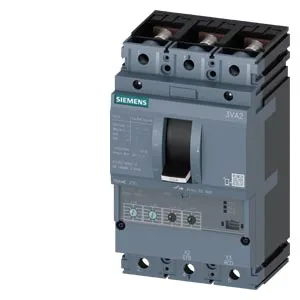
The ETU350 gives you adjustable time-current curves (L, S, I, G) via DIP switches or rotary dials on the front face, so you can coordinate selectively with downstream breakers without changing the trip unit itself. Breaking capacity at 240 V is 242 kA — that is the maximum fault current it can safely interrupt at that voltage without welding contacts or rupturing the case; at 690 V the same breaker derates to 4.5 kA, so verify your system's available fault current at the point of installation.
The 250 A rating holds flat from 40 °C to 50 °C ambient; above that it begins to taper — 241 A at 55 °C, 232 A at 60 °C, 222 A at 65 °C, and 213 A at 70 °C.
Breaking capacity across voltages — selectivity planning
The 3VA2225-6HN32-0HD0 delivers 242 kA at 240 V, 187 kA at both 415 V and 440 V, 121 kA at 500 V, and 4.5 kA at 690 V. These are the maximum interrupting ratings at each voltage level; they define the upper bound for fault current the breaker can clear while maintaining its integrity. When designing selective coordination, use the rating at your system voltage — not the highest number on the datasheet — because a 690 V fault sees only 4.5 kA of interrupting capability, which may be lower than the available fault current in a 690 V distribution panel.