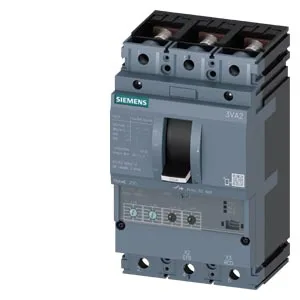
What the ratings mean for your panel
The Siemens SENTRON 3VA2225-6HN32-0JL0 is a 3-pole molded case circuit breaker rated for 250 A continuous current at 40 °C, with a 242 kA interrupting capacity at 240 V — that is the short-circuit current it can safely clear without welding contacts or rupturing the case, which is the number that governs fault protection in a distribution panel. At 415 V the interrupting rating drops to 187 kA, and at 690 V it falls to 6 kA, so the voltage class of your supply determines whether this breaker has the headroom for a fault. The ETU350 electronic trip unit handles the overload and short-time protection curves, with a shunt trip (STL) for remote opening and a full auxiliary contact set: 2 auxiliary switches + 1 trip alarm + 1 electrical alarm switch HQ. Ambient derating is baked in: the breaker holds 250 A up to 50 °C, then drops to 241 A at 55 °C and 213 A at 70 °C. In a cement plant control room that runs 50–55 °C near the kiln MCC, you plan for the derated figure, not the nameplate. The operating range spans -25 °C to 70 °C, so it eats the dust and runs in a hot enclosure without condensation worries.
Lifecycle and sourcing reality
The basic switch variant is 3VA2225-6HN32-0AA0, and the integrated auxiliary trip is 3VA9688-0BL32 — both are the internal sub-assemblies, not field-replaceable by a panel builder, but they confirm the breaker's internal architecture for spares planning.
Panel fit and integration
Dimensions are 86 mm deep, 105 mm wide, 181 mm tall — a standard 3-pole MCCB footprint for a 250 A frame. It mounts on a DIN rail or directly to a backplate; the 105 mm width means it occupies the same slot as other SENTRON 3VA2 breakers, so swapping a 160 A unit for this 250 A version does not require re-drilling the sub-panel. Maximum power loss is 48 W at rated current — that heat has to be managed inside the enclosure. In a sealed panel with no fan, 48 W per breaker adds up; a cement plant's motor control center with a dozen of these needs either forced ventilation or a larger cabinet to stay below 55 °C where the derating curve starts.
