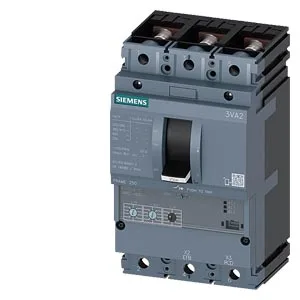
The 3VA2225-7HL32-0KH0 carries a continuous current rating of 250 A at 40 °C, and it holds that full 250 A through 50 °C ambient — no derating needed up to that point. At 55 °C it drops to 241 A, then 232 A at 60 °C, 222 A at 65 °C, and 213 A at 70 °C.
Breaking capacity by system voltage
Breaking capacity varies sharply with voltage. At 240 V it interrupts 330 kA; at 415 V and 440 V it handles 242 kA; at 500 V it drops to 187 kA. At 690 V the rating falls to 4.5 kA — that's the limit for a 690 V line, and it means this frame is not intended for high-fault 690 V applications. For a 480 V panel (common in North America) the 187 kA figure at 500 V is the relevant bound, and it gives substantial headroom for most industrial service-entrance or feeder duty.
Adjustable trip range and internal configuration
The thermal-magnetic trip is adjustable from a minimum of 375 A up to a maximum of 2 500 A. That range covers feeder protection for downstream subpanels or large motor circuits.
Power loss at full rated current is 48 W maximum — account for that in the enclosure thermal calculation, especially if multiple breakers are ganged.
Temperature and storage range
The storage minimum is the relevant bound for cold warehouses or unheated shipping — the breaker can sit at -40 °C without damage, but it must be warmed above -25 °C before energizing.