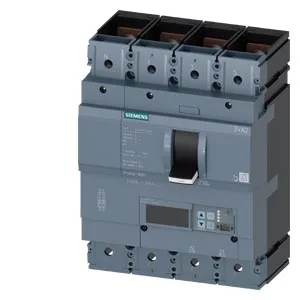
The Siemens 3VA2463-7JP42-0AA0 is a SENTRON molded case circuit breaker (MCCB) rated for 630 A continuous current at 40 °C, with four poles and an ETU550 electronic trip unit. Its interrupting capacity hits 330 kA at 240 V and 242 kA at 415 V — that's the kind of fault-clearing headroom you spec for high-capacity transformer secondaries or large motor control centers where bolted-fault currents run high.
Ratings and what they mean for your panel
The 630 A continuous rating is the frame's thermal limit at 40 °C ambient. Push the ambient to 50 °C and you derate to 570 A; at 60 °C you're at 510 A. That derating curve is what you use for a panel sitting next to a furnace line or inside a non-conditioned enclosure — the 40 °C number is the catalog headline, but the 50 °C or 60 °C row is the one that governs your real installation. The ETU550 is a microprocessor-based trip unit with adjustable long-time, short-time, instantaneous, and ground-fault protection. It communicates — the listing flags a communication function — so it can talk to a higher-level monitoring system for power metering and event logging. No undervoltage release or voltage trip built in, so if you need UVR you add it externally. Breaking capacity: 330 kA at 240 V, 242 kA at 415/440 V, 187 kA at 500 V, and 9 kA at 690 V. That 9 kA at 690 V is the number to watch if you're on a 690 V distribution — it's still adequate for most industrial services, but it's not the headline figure. For 480 V systems common in North America, the 242 kA at 440 V is the closest published point; expect similar performance at 480 V.
Physical fit and panel integration
Dimensions: 248 mm tall, 184 mm wide, 110 mm deep. Four-pole frame means it occupies a 184 mm-wide slot on the DIN-rail or panel-mount footprint — standard for a 630 A MCCB in this class. Front IP40 protection keeps dust out of the trip-unit interface; the body itself is rated for enclosed panel mounting, not open-air washdown.
