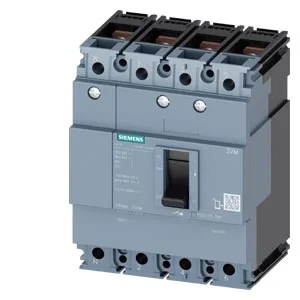
The interrupting capacity is 76 kA at 240 V AC, 53 kA at 415 V, 32 kA at 440 V, and 7.5 kA at 500 V — meaning it can safely clear a bolted fault at those levels without welding contacts or rupturing the case. Rated insulation voltage Ui is 690 V, and the maximum operational voltage on DC circuits is 500 V. The TM210 release has a fixed I²t characteristic; the lg (long-time pickup) is adjustable down to 50 A minimum. That adjustment range covers the full 50 A rating — no derating needed at the top end.
Above that, the thermal curve drops: 49 A at 55 °C, 48 A at 60 °C, 46 A at 65 °C, 45 A at 70 °C. Mounting footprint is 101.6 mm wide (4 in), 130 mm tall (5.1 in), 70 mm deep (2.8 in). The back and sides are open-frame, so clearance to grounded metal in the enclosure matters.
What the TM210 release means for coordination
The TM210 is a thermal-magnetic release: the thermal element (bimetal) handles overload protection with an inverse-time curve; the magnetic element (solenoid) provides instantaneous short-circuit protection. It is not electronic — no adjustable short-time pickup or I²t-on-demand. That makes it a straightforward choice for feeder protection where selectivity with downstream MCBs is achieved by time grading (the MCCB's magnetic trip is slower than a miniature breaker's instantaneous). For systems requiring zone-selective interlocking or ground-fault alarm, this is not the right variant — the 3VM series offers electronic releases in other order codes.
The SENTRON 3VM series carries IEC 60947-2 certification for MCCBs. The front-face protection class is IP40.