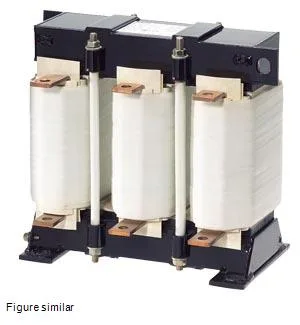
The Siemens 4EU4521-0BL10 is a three-phase commutating choke (line reactor) for converter applications, rated 2250 A at 500 VAC, 50 Hz. The 13 µH inductance and 4% relative inductive drop are sized to limit di/dt and reduce harmonic stress on the converter's semiconductor switches — critical when the drive is feeding a high-current motor load or when multiple drives share a common DC bus. This is a heavy-current, open-frame (IP00) component, so it lives inside a ventilated cabinet; no washdown tolerance, no touch-safe enclosure. Thermal class H (IEC 60085) means the winding insulation withstands 180 °C hotspot temperature, which aligns with the 1080 W total power loss (680 W copper + 400 W iron) at the 40 °C ambient rating.
The 2250 A rated current is the thermal continuous current (Ith) at 50 Hz — this is not a short-time rating; it governs the conductor sizing, busbar connections, and cabinet cooling. The flat-type terminals accept busbar or large cable lugs; plan for bolted connections, not spring clamps. The 4% relative inductive drop (Uk) is measured at rated current, voltage, and frequency — it tells you the voltage drop across the choke at full load, which is the design parameter for the converter's DC-link voltage margin. If your drive is already at the upper end of its input voltage tolerance, a 4% drop is significant; verify the converter's minimum operating voltage before committing. The 0.293 m depth × 0.46 m width × 0.435 m height footprint is a floor-standing or bracket-mount package — no DIN rail, no panel cutout. IP00 means no ingress protection; the choke must be installed in a clean, dry, ventilated enclosure with clearance for airflow around the 1080 W heat dissipation.
The 2250 A DC rated value (2757.3 A) is the continuous DC current the choke can carry when used in a DC-link application — higher than the AC rating because there is no skin effect or core loss from AC magnetization. If you are placing this choke in the DC link of a large drive, that is the number to size your busbars and fuse protection against.