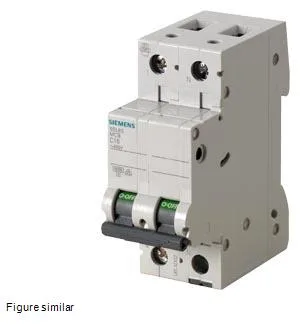
The 6 kA breaking capacity per EN 60898 means it can safely interrupt a fault current up to 6,000 A at 230 V, which covers the majority of domestic and small commercial service entrances. The 1P+N pole configuration switches both the line and neutral, but only the line pole is protected — the neutral pole is switched only, not monitored for overcurrent. This is common in single-phase final subcircuits where the neutral is not fused. The part occupies 2 modular width units (36 mm) on a DIN rail, with a depth of 76 mm and an installation depth of 70 mm — it fits standard 18 mm per-module spacing used in SENTRON and most European distribution boards.
The 2 MW width (36 mm) means it takes up two 18 mm slots in a distribution board — check fill factor if you are retrofitting into a densely populated enclosure. Supplementary devices (arc-fault, surge, shunt trip) can be added on the right side via the product extension feature.
The closest functional peer in the same SENTRON 5SL family is the 5SL6516-6YA, which is a 16 A B-curve 1P+N MCB with identical dimensions (76 mm depth, 36 mm width, 90 mm height) and the same 6 kA breaking capacity. The only difference that matters for selection is the current rating: 10 A vs 16 A. If your BOM line calls for 10 A protection, the 5SL6510-6CC is the correct part — the 16 A sibling would not trip on a 12 A overload. The mechanical service life, temperature range, and mounting footprint are identical, so a panel designed for one can take the other without rewiring, provided the conductor sizing and load match the higher current.