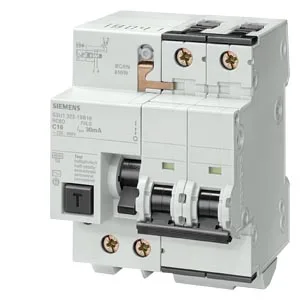
It belongs to the SENTRON 5SU1 family and carries a 32 A rated current with a C tripping curve, a 30 mA AC-type residual trip, and a 4.5 kA breaking capacity per EN 60898 with a 15 kA rating per IEC 60947-2. That dual standard means it's certified for both residential-distribution board duty (EN 60898) and industrial panel applications (IEC 60947-2), so the same unit covers a wider fault-current envelope than a single-standard device.
The 30 mA residual trip (type AC) catches sinusoidal AC earth faults, which covers the majority of general-purpose circuits in commercial and light-industrial panels. For circuits with pulsed DC fault currents (variable-speed drives, UPS systems), you'd want a type A or F device instead; this type AC is the right call for resistive and standard inductive loads. The 4.5 kA / 15 kA breaking capacity tells you this unit can safely interrupt a fault up to 4.5 kA under EN 60898 (the standard for household and similar installations) and up to 15 kA under IEC 60947-2 (the industrial standard). In practice, if your panel's prospective short-circuit current (PSCC) exceeds 4.5 kA at the board, the 15 kA rating under 60947-2 is what you lean on — but verify your supply transformer's impedance and cable lengths to confirm the fault level at the RCBO terminals stays within that 15 kA ceiling.