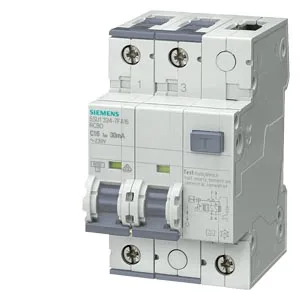
What this RCBO brings to the panel
The Siemens 5SU1324-6FM16 is a 2-pole RCBO from the SENTRON 5SU1 series, combining overcurrent protection and residual current detection in a single 3-module-wide (54 mm) package. It carries a 16 A rated current at AC with a B tripping characteristic, and a Type A fault current sensor that catches pulsating DC as well as sinusoidal AC earth faults — the standard choice for circuits feeding single-phase electronics, pumps, or small motor loads where VFDs or switching power supplies may generate smooth DC leakage. Rated breaking capacity hits 10 kA per EN 60898, which covers the majority of residential and light commercial distribution boards. The 10 kA SCCR means this device safely interrupts a fault up to that level without welding contacts or cascading the arc upstream to the main breaker — a standard spec for TN and TT systems in most European and Asian installations.
Temperature derating — the real current you get
The 16 A nameplate rating holds at 30 °C ambient. Above that, the RCBO derates linearly: 15.2 A at 40 °C, 14.88 A at 45 °C, 14.4 A at 50 °C, 13.92 A at 55 °C, 13.6 A at 60 °C, and 12.96 A at 65 °C, bottoming at 12.32 A at 70 °C. If your panel runs hot — say, a packed enclosure near a furnace line or a roof-mounted DB in direct sun — size the upstream load to the derated figure at your actual ambient, not the 30 °C sticker. Operating ambient range is -25 to +55 °C; storage range extends -40 to +75 °C. The derating curve above 55 °C is provided for reference but the device's published operating limit is 55 °C — running it above that ambient without a verified thermal analysis risks nuisance tripping or reduced service life.
Terminal capacity and wiring
Both solid and stranded conductors from 0.75 mm² up to 35 mm² fit the terminals — enough for a 16 A feed-through or a downstream sub-feed. The 77 mm depth and 70 mm installation depth mean it sits flush in a standard 3-module DIN cutout; mounting position is any orientation, and the supply can enter from top or bottom. IP20 applies once the distribution board is installed and conductors are connected — this is an enclosed-panel device, not a standalone outdoor unit.
Lifecycle and compliance
Overvoltage category III and energy limiting class 3 place it in the permanent-mains installation tier. The product designation (RCBO) and design (instantaneous) mean it trips on fault without intentional delay — no selective or time-delayed variant here.
