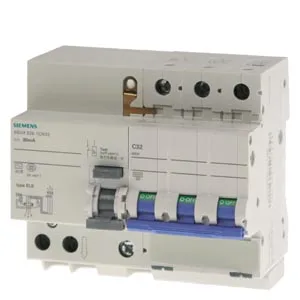
That dual rating means the same part satisfies residential distribution boards and light industrial sub-distribution without a separate coordination study at the 6 kA fault level. The 30 mA residual trip is AC-type, so it detects sinusoidal AC earth faults only. For pulsed DC or smooth DC fault currents (common on VFD-fed circuits or EV chargers), you would need an A-type or B-type RCBO — this part is not a fit there. The C-curve (magnetic trip at 5–10× In) handles motor start and capacitor bank inrush without nuisance tripping, but on highly inductive loads verify the inrush peak stays under 400 A (10 × 40 A). Thermal derating is published: 40 A at 30 °C, 37.2 A at 40 °C, 35.2 A at 45 °C, 34.4 A at 50 °C, and 33.2 A at 55 °C. If the panel ambient runs at 40 °C, the usable continuous current drops to 37.2 A — size the downstream load accordingly. That means it's designed for fixed-installation distribution boards with transient overvoltages up to 4 kV — standard for building-level sub-distribution.
The 5SU9336-1CN40 occupies 6 modular width units (108 mm) on a DIN rail, with a depth of 77 mm and an installation depth of 70 mm. Mounting position is any orientation. The supply cable can enter from either top or bottom.