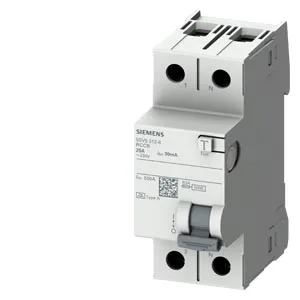
Residual current protection for standard AC circuits
The Type AC designation means it detects sinusoidal AC residual currents only; it is not rated for pulsed DC or smooth DC fault currents, so it belongs in circuits without variable-speed drives, LED drivers, or other non-linear loads that generate complex fault waveforms. The let-through energy (I²t) is rated at 58,000 A²·s, and the peak let-through current is 5,200 A — figures needed for coordination with upstream protective devices. The unit occupies 2 modular width units (36 mm) on a 60 mm grid DIN rail, with a depth of 70 mm and height of 90 mm, fitting standard enclosure cutouts. This is an instantaneous (non-time-delayed) RCCB, meaning it trips without intentional delay on a residual fault. It is not suitable for use where a short-time delay is needed to achieve selectivity with downstream devices. The IP20 rating applies when installed in a distribution board with conductors connected — the device itself is not sealed against moisture ingress.
Spring-cage terminals accept copper conductors; strip length and torque values follow standard practice for the terminal cross-section. The silicon-free construction (verified per manufacturer spec) is relevant for applications in paint shops or coating lines where silicone outgassing can cause surface defects.