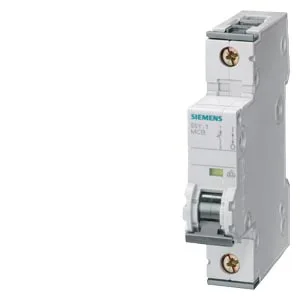
It avoids nuisance tripping on inrush from motor-starting loads, which would call for a C or D curve. At 40 °C ambient the 6 A rating derates to 5.63 A; at 55 °C it drops to 5.04 A. If the panel runs warm — say, a crowded DIN rail inside an enclosure with no forced cooling — the actual continuous current the MCB can carry without nuisance tripping is lower than the 6 A nameplate. Check the derating curve against your worst-case enclosure temperature. The 35 kA figure applies under the industrial standard, so it is suitable for sub-distribution in high-fault-capacity installations where a standard 10 kA MCB would need a current-limiting upstream device.
This MCB is designed for railway applications per the product designation, but it is also listed for general mechanical engineering and industry use. The 76 mm depth includes the quick-assembly fastening system; the installation depth is 70 mm. Combined top and bottom terminals allow daisy-chaining without extra bridging links, saving space in a crowded gland plate layout.
It carries touch protection on the terminals and is sealable for tamper-proof installations. The product is designed to DIN EN 60898-1 (the household and similar installations standard) and also meets IEC 60947-2 for industrial applications. Overvoltage category III suits fixed installations in building distribution. The energy limitation class is 3, meaning it limits let-through energy to a low level under fault conditions.