What the ratings mean for fit
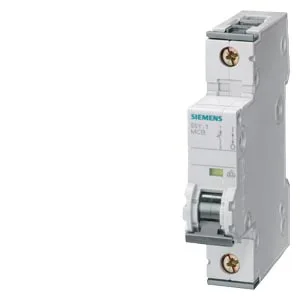
The Siemens SENTRON 5SY7113-7CC is a 1-pole miniature circuit breaker with a C tripping characteristic, rated 400 V AC and 25 kA per IEC 60947-2. The C-curve means it trips at 5 to 10 times rated current — standard for motor and lighting circuits where moderate inrush is expected. The 25 kA breaking capacity per IEC 60947-2 tells you it can safely interrupt a fault current up to that level without upstream damage, provided the available fault current at the panel doesn't exceed it. Under UL 1077 and CSA C22.2 No. 235, the rating is 5 kA — a different standard, not a derating; verify which applies to your installation jurisdiction. The 18 mm width occupies exactly one modular unit on a DIN rail, so it fits standard 18 mm-per-pole panel layouts. The 76 mm depth and 70 mm installation depth mean it clears most enclosure depths, but check gland-plate clearance if the backplane is tight. Mounting position is any, which simplifies layout in crowded cabinets.
Environmental and compliance
Halogen-free and silicon-free construction, which matters in clean-room or semiconductor-adjacent installations where outgassing can contaminate optics or sensitive surfaces. Sealable design allows the installer to lock the toggle position — useful for tamper-proofing in public-access panels. Pollution degree 3 and overvoltage category III mean it's rated for industrial environments with conductive contamination and transient overvoltages up to 4 kV. Rated for ambient temperature from -40 °C to 75 °C, with derating on humidity: max 95% RH at 55 °C, tapering to 35% RH at 75 °C. That covers unheated outdoor enclosures and hot machine cabinets. Vibration resistance per IEC 60068-2-6: ±1 mm at 5 to 25 Hz, 50 m/s² at 25 to 150 Hz — adequate for industrial machinery but not for direct mounting on high-vibration equipment without isolation.
Panel integration notes
Snap-on DIN rail mounting via the quick assembly system. Combined terminal top and bottom accept both busbar and conductor connections — no need to remove the busbar to wire the load side. Supplementary devices (auxiliary contacts, shunt trips, alarm switches) can be installed on the right side per the manufacturer's accessory range. Power loss is 1.4 W per pole at rated current in hot operating state — negligible for thermal budgeting in a multi-pole panel.
