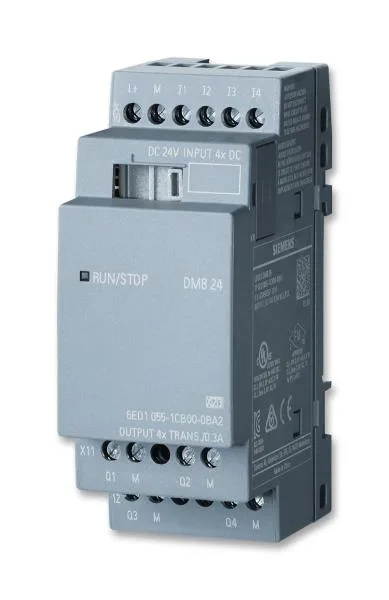
Module identity and I/O map
The Siemens 6ED1055-1CB00-0BA2 is a LOGO! DM8 24 expansion module for the LOGO! 8 logic module family. It provides 4 digital inputs and 4 digital outputs in a compact 35.5 mm wide housing that snaps onto a standard 35 mm DIN rail, occupying 2 spacing units. The 4 outputs are transistor type, rated for 0.3 A per channel at signal "1", with a maximum switching frequency of 10 Hz into resistive loads and 0.5 Hz into inductive loads. This means the module is best suited for driving small contactors, indicator lamps, or solenoid valves at moderate cycle rates — not for high-speed pulse trains or heavy motor contactors. Input thresholds are defined for 24 V DC logic: signal "0" below 5 V DC, signal "1" above 12 V DC, with a typical input current of 2.1 mA at signal "1". The permissible supply range is 20.4 V to 28.8 V DC, so it holds regulation through a sagging 24 V bus.
Switching performance and protection
Transition times are symmetrical: 1.5 ms max for both 0-to-1 and 1-to-0 edges. That gives a practical minimum pulse width around 3 ms, which is fine for most discrete control signals but not for encoder pulse counting. The module includes short-circuit protection on the outputs, so a downstream wiring fault won't take out the output transistor — useful when commissioning in a panel where a stray wire strand might short to ground. Maximum quiescent current at signal "0" is 0.88 mA, which keeps the input off-state leakage low enough to avoid false triggering on long cable runs where capacitive coupling might otherwise hold a line above the 5 V threshold.
Environmental limits and approvals
Rated for 0 °C to 55 °C ambient — the standard industrial range for a panel-mounted logic module. Units with firmware ES03 and higher extend the low end to -20 °C, which matters for cold storage or unheated enclosure applications. Carries UL, CSA, CE, FM, and marine approvals, so it's accepted in North American, European, and shipboard panels. Developed in accordance with IEC 61131 and VDE 0631, and rated limit class B for residential interference limits.