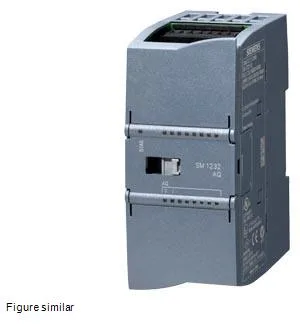
What you're looking at
No heater needed for cold starts, and no derating worry in a typical panel at 55 °C horizontal.
The diagnostics are the real time-saver out here in the grease: it knows when an output wire breaks, when there's a short circuit, or when the supply voltage drops. That 'Alarm' and 'For Maintenance' capability means you can catch a dying sensor or a pinched cable before the line stops. The module also monitors its own supply voltage – one less thing to troubleshoot. With current outputs, max load resistance is 600 Ω. With voltage outputs, min load is 1 000 Ω. Common-mode voltage between outputs maxes at 12 V.
The obvious alternative on the shelf is the SIPLUS variant 6AG1232-4HD32-2XB0. Both modules share the identical footprint, front connector, and wiring pinout – you can swap one for the other without touching the panel wiring. The difference is environment. This standard 6ES7232-4HD30-0XB0 carries IP20 and the -40 to 70 °C range. The SIPLUS extends that temperature range, adds conformal coating for condensation and corrosive gases, and carries a different approval suite (ATEX/IECEx for gas and dust). If your cabinet sits in a clean, conditioned room, stay with this standard module. If the panel is out in the grease or near a hot bearing, the SIPLUS is the one to spec.
Certifications and compliance
This module carries CE, FM, and RCM (C-TICK) approvals – the usual suspects for a standard S7-1200 I/O. RoHS and REACH declarations are available from Siemens on request, but aren't listed on the module itself. Atmospheric pressure tolerance: 795 to 1 080 hPa during operation, 660 to 1 080 hPa during storage.