What the 16 kbyte working memory means for your program
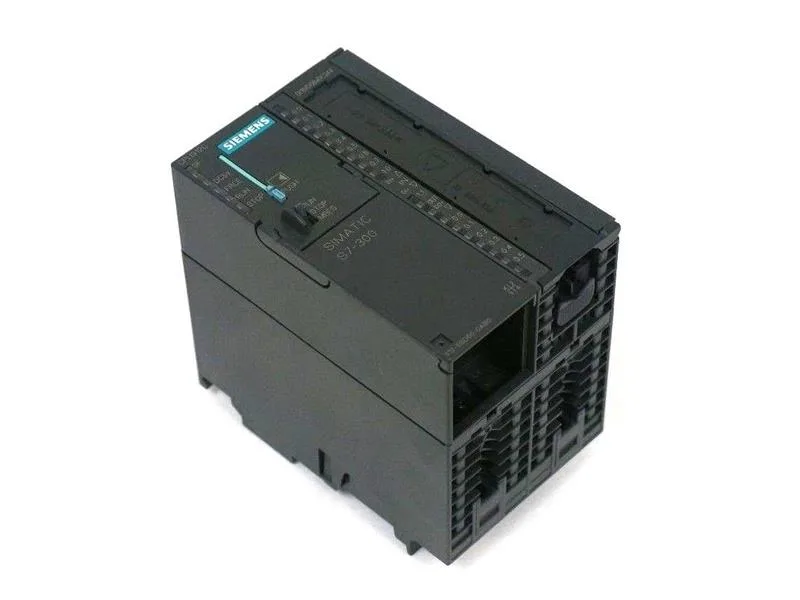
The Siemens 6ES7312-5BD00-0AB0 CPU 312C has 16 kbyte of integrated working memory for program and data. It supports LAD, FBD, STL, SCL, GRAPH, and HiGraph.
I/O count and onboard function modules
This CPU integrates 64 digital inputs and 32 digital outputs right on the module — no separate I/O card needed for those points. The inputs are 24 VDC, with a signal "1" threshold from +15 to +30 V and a signal "0" from -3 to +5 V, so it handles standard 24 V sensor levels cleanly. It also supports 2-wire proximity sensors directly. Four function modules (FM) are built in — these are the counter, positioning, or pulse-width modulation channels that would otherwise eat up a slot in the rack. For a machine with a few encoder inputs or a simple positioning axis, that saves a slot and a separate FM card.
Communication and expansion limits
The CPU has one integrated MPI interface for programming and HMI communication. It can also take one CP for PROFIBUS (via CP) and one CP for Industrial Ethernet (CP, LAN), plus two point-to-point CPs (CP, PtP) for serial devices like drives or barcode scanners. That gives you three communication channels beyond the MPI bus without an external switch. It supports one rack maximum — no multi-rack expansion. The CPU can act as an MPI server but not as a client. The number of modules overall is 6, including the CPU itself, so you have five slots left for signal or function modules. Shielded cable runs up to 1 000 m on the MPI bus.
The 6ES7312-5BD00-0AB0 is an established S7-300 CPU — no official lifecycle status on record, so it is sourced to order against the BOM quantity.