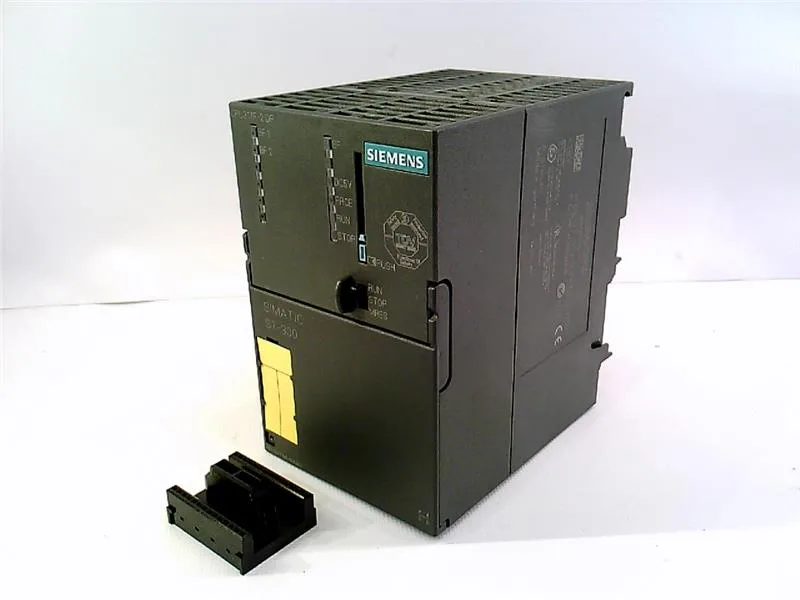
DIN-rail fail-safe CPU with 8-entry fault buffer
The Siemens 6ES7317-6FF00-0AB0 is an S7-300 fail-safe CPU (CPU 317F-2 DP) that snaps onto a standard DIN rail and occupies the same 80 mm width as other S7-300 CPUs, so it fits existing rack layouts without panel rework. Its fault memory (FM) holds 8 entries — enough to capture the last eight safety-related events before a shutdown, which is useful for diagnosing the sequence of a fault in a safety circuit without needing a separate diagnostics tool. The CPU supports programming in LAD, FBD, SCL, and STL, but requires STEP 7 V5.2 SP and higher plus S7 Distributed Safety V5.2 SP1 and higher — confirm your engineering station has these versions before downloading.
Work memory, I/O map, and expansion limits
Work memory is 64 KB maximum, which limits the compiled code size for the safety program and standard logic combined — plan the application to fit within this ceiling. The I/O address space is 244 bytes each for inputs and outputs, with 32 overall I/O modules maximum across up to 4 racks. This supports medium-sized safety applications but not large distributed I/O farms. Two integrated DP interfaces handle PROFIBUS DP communication; the CPU can also act as a DP client via CP and loadable FB and as a DP server, so it folds into a mixed PROFIBUS network without a gateway hack.
Backup, retentivity, and real-time clock
The backup time is 6 weeks at 40 °C ambient temperature — enough to retain the program and retentive data through a short plant shutdown, but plan for a memory card if the power-off period exceeds that. Retentive data must be restarted at each restart, meaning the CPU does not automatically restore the last state of retentive variables after a power cycle — the program must handle re-initialization. The real-time clock has a granularity of 1 hour and a lower limit of 10 ms, so time-stamped events are accurate to the hour but not sub-second — adequate for shift-based logging, not high-speed sequence-of-events.