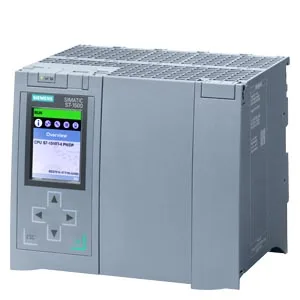
What keeps the machine running in a pulp mill environment
The Siemens 6ES7518-4TP00-0AB0 CPU 1518-4 PN/DP is the top-end controller for the S7-1500 family, built for continuous processes where an unplanned shutdown costs tonnes on the reel. It carries a -40 to 70 °C operating range, so it survives the steam and the chemicals in a recovery boiler area or a wet-end machine room without a climate-controlled cabinet. MRP (Media Redundancy Protocol) support with MRP Automanager according to IEC 62439-2 Edition 2.0 means the CPU can manage a ring-topology network and reconfigure around a cable break in under 200 ms — critical for keeping the distributed I/O and drives communicating when a vibration or washdown damages a connector. MRPD (Media Redundancy for Planned Duplication) is also supported but requires IRT, which this CPU does not have natively.
Network redundancy and high-speed backplane
The CPU 1518-4 PN/DP offers a 1 Gbps interface on the X3 port — that is the PROFINET backplane for high-speed data exchange between the CPU and distributed I/O stations over fibre or copper. The two additional PROFINET ports run at 100 Mbps. For plants with a flat network architecture, DCP (Discovery and Configuration Protocol) support and DNS let the engineering station find and address the CPU without hard-coded IP addresses — useful when swapping a failed unit in a hurry. Up to 8 communication modules (CMs/CPs) can be inserted for PROFIBUS, additional Ethernet, or serial connections like RS-485 via the X4 interface. MODBUS TCP is supported natively, so tying into legacy flow meters or analysers does not require a separate gateway.
Process image and integrated control loops
The process image handles 32 kB of inputs and 32 kB of outputs — all I/O data is in the image, so the application logic reads and writes directly without additional data management. Forcing is supported, which helps during commissioning when you need to override a sensor value to test a sequence without physically simulating the field device. Integrated PID controllers for temperature (PID-Temp) and valve positioning mean the CPU can close loops on dryer-section steam valves or consistency control valves without an external loop controller. The PID-Temp block includes integrated optimisation, so tuning is automated on startup.
Safety separation — no PROFIsafe here
This CPU does not support PROFIsafe. For safety applications — emergency stops, light curtains, press guarding — you need a separate fail-safe CPU (e.g. the 1518F variant) or a safety module on the backplane. The standard CPU handles the standard logic; the safety CPU handles the SIL-rated circuit. Keep them on separate PROFINET domains if you run MRP on the standard ring.