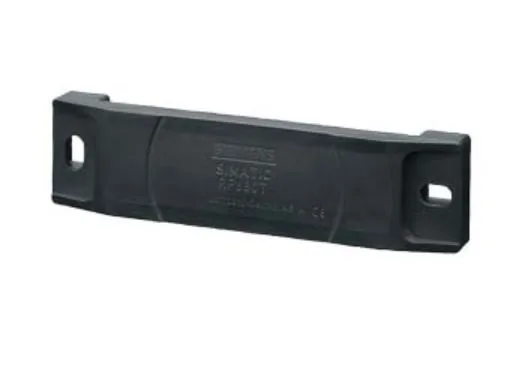
The Siemens 6GT2810-4HC80 is a SIMATIC RF622T large-memory RFID tag built for the RF600 system. It's a passive, read/write transponder using a Fujitsu MB97R803 chip with FRAM memory — no battery to replace, which is one less thing to track in the storeroom. The tag operates across 860 to 960 MHz, covering global UHF bands, and communicates via EPCglobal Class 1 Gen 2 / ISO 18000-63 protocol at up to 320 kbit/s. The housing is PA12, anthracite, sized 120 mm wide by 30 mm deep by 6.5 mm thick. IP67 rating means it handles washdown and outdoor exposure — suitable for mounting on totes, pallets, or equipment in a production environment where moisture or dust is present. It's also silicon-free, which matters for paint-shop or coating-line applications where silicone contamination is a concern.
Memory and data handling
User memory is 3424 bytes, stored in FRAM — fast writes and high endurance compared to EEPROM. The EPC memory starts at 96 bits (12 bytes) with a sequential identifier and is expandable up to 496 bits (62 bytes). TID memory is 512 bits (32 bytes). The memory supports lock, unlock, write protection, and password protection, so you can secure data once written. The tag is multitag-capable, meaning multiple tags can be read in the same field simultaneously — useful for reading a pallet load of tagged items in a single pass. Read range is reader-dependent and can exceed 3 m under the right conditions; the system manual (reference 67384964) covers overrange scenarios.
Environmental limits and mounting
During read/write access, the tag operates from -20 to +85 °C. Outside the read/write area, it survives -40 to +85 °C. Storage range is -40 to +80 °C. Shock resistance is tested to DIN EN 60721-3-7 Class 7M3 at 1000 m/s², and vibration resistance is 500 m/s². Note that torsion and bending stress are not permissible — mount it on a flat surface using the two M4 screws and the supplied spacers. The tag is printable via laser inscription, so you can add a barcode or human-readable label directly onto the housing. That's useful for visual identification alongside the RFID read.