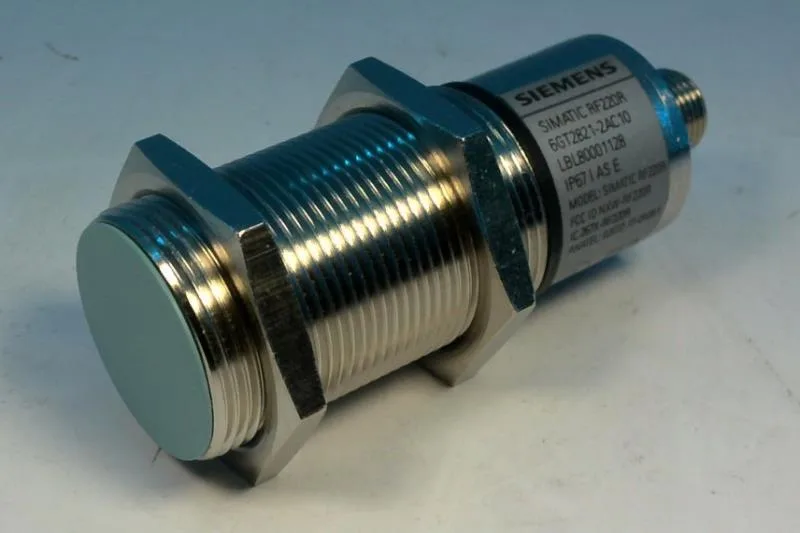
Siemens 6GT2821-4AC11 — RFID & Auto-ID

Siemens 6GT2821-4AC11 RF240R RFID Reader, RS-232, IP67, 13.5

MPN6GT2821-4AC11

Siemens SIMATIC RF200 RF240R RFID reader, 6GT2821-4AC11, RS-232 interface (3964R), IP67, 13.56 MHz, 65 mm range, 50 x 50 x 30 mm, with integrated antenna.

$204.47Ref. price · indicative, final on quote
Source DocumentedChannel stated on listing & quote
Condition PhotosReal unit photos / video on request
WhatsApp AnswersFast human replies for machine-down parts
Worldwide DispatchDHL/FedEx — transit quoted per order
Independent China distributor & sourcing agent· Listing updated Sep 2026

Specifications

6GT2821-4AC11 — RF / Air interface
ParameterValue
Operating frequency (rated)13.56 MHz
Supported RF protocolsISO 15693, ISO 18000-3
Compatible transponders / systemsISO 15693 Transponder (MDS Dxxx), for connecting to PC systems (3964R protocol)
Read/write range, max.65 mm; Range is dependent on transponder type: observe http://support.automation.siemens.com/WW/view/en/67384964
Air-interface data rate, max.26.5 kbit/s
Multitag capableNo
6GT2821-4AC11 — Performance
ParameterValue
Read time per byte (typ.)0.6 ms
Write time per byte (typ.)0.6 ms
MTBF430 y
6GT2821-4AC11 — Communication / Electrical
ParameterValue
Communication interfacesRS232
Electrical connector typeM12, 8-pin
Voltage range (DC)20.4 ... 28.8 V
Rated value (DC)24 V
Current at 24 V (typ.)0.05 A
Status indicators (LEDs)3-color LED
6GT2821-4AC11 — Mechanical
ParameterValue
Mounting / fastening method2 x M5 screws
Width50 mm
Height30 mm
Depth50 mm
MaterialPA6.6
Coloranthracite
6GT2821-4AC11 — Environmental
ParameterValue
Degree of protection (IP)IP67
Operating temperature range-20 ... +70 °C
Storage temperature range-25 ... +80 °C
Transport temperature range-25 ... +80 °C
Shock acceleration500 m/s²
Vibration acceleration200 m/s²
Shock resistance standardEN 60721-3-7 Class 7 M2
6GT2821-4AC11 — Approvals
ParameterValue
IECEx certifiedNo

Product details

The Siemens 6GT2821-4AC11 is a SIMATIC RF200 RF240R RFID reader with an integrated antenna, communicating via RS-232 using the 3964R protocol. It operates at 13.56 MHz and reads ISO 15693 and ISO 18000-3 transponders (MDS Dxxx types), with a maximum range of 65 mm — though that range depends on the specific transponder in use.

IP67 means the reader body is dust-tight and survives submersion in 1 m of water for 30 minutes — suitable for washdown zones on a production line, but not for continuous immersion or pressurized spray. The housing is PA6.6 in anthracite, fastened with two M5 screws, so it mounts directly to machine frames or brackets without a DIN rail. The 24 V DC supply (20.4 to 28.8 V range) draws 0.05 A typical — low enough to power from a standard 24 V sensor supply without worrying about the line drop over a 30 m RS-232 cable run. The RS-232 interface supports cable lengths up to 30 m, which is the practical limit for that protocol before signal degradation sets in. Read and write access times are both 0.6 ms per byte typical. For a 16-byte UID read that's under 10 ms, but if you're writing larger data blocks (say 128 bytes of user memory) expect roughly 77 ms per block — factor that into your cycle time budget. The reader is not multitag-capable, so it reads one transponder at a time. The 13.56 MHz HF band gives it better performance around metal and liquids than UHF, but the range is still limited to 65 mm max — this is a close-proximity station, not a conveyor portal reader.

Deployment context

This reader is designed for stationary read points on assembly lines, tool identification in machining centers, or access control at workstations where you need to identify a part or tool carrier within a 65 mm window. The RS-232 with 3964R protocol means it connects directly to a PC serial port or a serial-to-USB converter — no fieldbus gateway required, but you're limited to point-to-point topology. The 50 x 50 x 30 mm footprint and M5 mounting make it easy to retrofit into existing fixtures. The M12 8-pin connector carries both power and RS-232 signals, so keep the cable assembly short to maintain signal integrity — 30 m is the maximum, but for reliable communication in a noisy plant I'd keep it under 15 m and use shielded cable with the shield grounded at one end. The silicon-free construction matters if this goes into a paint shop or coating line where silicone contamination causes adhesion failures.

Frequently asked questions

What is the MTBF for this reader?

The listed MTBF is 430 years. This is a calculated reliability figure under controlled conditions — in a real plant with vibration, temperature cycling, and electrical noise, field life will be lower, but it indicates a robust design.

What compliance documentation is available?

The reader carries CE marking as a Siemens SIMATIC product. It's silicon-free and built to EN 60721-3-7 Class 7M2 for shock and vibration resistance. Specific RoHS/REACH declarations are available from Siemens upon request.

Will this reader work with existing Siemens RFID tags?

Yes, it's designed for ISO 15693 transponders, specifically the MDS Dxxx series from Siemens. It also supports ISO 18000-3 tags. The maximum read range of 65 mm depends on the transponder type — larger tags give longer range.

MPN
6GT2821-4AC11