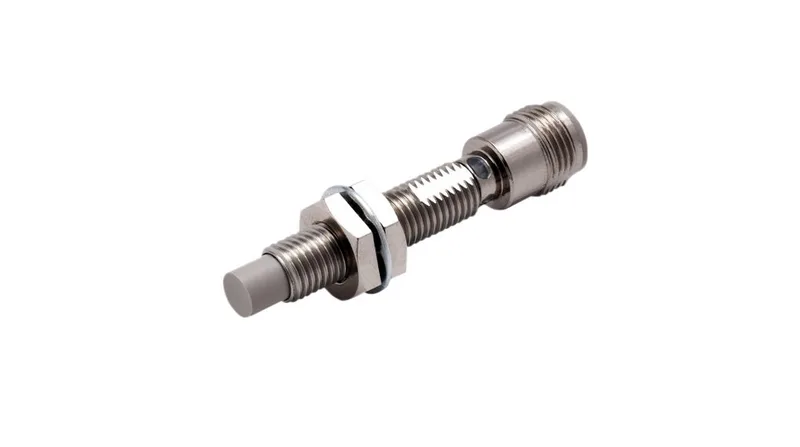
What this sensor is, in cabinet terms
The Omron E2EX4MB1TL8M1OMS is an M8 inductive proximity sensor from the E2E-Next series, terminated on an M12 4-pin connector with a 53 mm stainless steel body for non-flush mounting. Operates on 10 V to 30 V supply at 16 mA current consumption, with a PNP NO output rated for 200 mA load current. Inductive sensors in this class detect metal targets at close range for position confirmation, end-of-travel, and object-presence logic on conveyors, packaging lines, and assembly cells.
Sensing range, speed, and the washdown rating that actually matters
Sensing distance tops out at 4 mm in non-flush mounting, with a 1 kHz switching frequency — adequate for line-speed position sensing on most packaging and material-handling lines. The housing carries IP67 and IP69K ratings, which is the combination that opens high-pressure, high-temperature washdown deployments in food, beverage, and pharmaceutical cells — not just splash-proof enclosures. Operating temperature spans -40 °C to 85 °C, so the same part covers cold-chain conveyors and unconditioned outdoor cabinets without a special variant.
Lifecycle posture and sourcing path
The part is recorded as current production, so the standard Omron E2E-Next channel applies for new BOM lines and the broker/surplus path is not the primary route here. For a parallel-import desk, the same part arrives through an APAC or European authorized channel as the same device electrically, with regional service terms the only variable. Quoted against an RFQ for production volumes or a single-unit replacement, with no special last-time-buy window flagged on this code.
Against the E2EX4MB1TL8M5OMS second source
The closest functional second-source in the same E2E-Next family is the E2EX4MB1TL8M5OMS — same 4 mm non-flush sensing, same 200 mA PNP NO output, same -40 °C to 85 °C envelope — but it terminates on an M8 3-pin connector rather than the M12 4-pin on this part. That connector class is the decision point: an E2EX4MB1TL8M5OMS will not drop into a panel wired for an M12 4-pin pigtail without re-terminating the cordset, even though every electrical and sensing spec aligns. Body length is the secondary delta — 53 mm versus 49 mm on the M8 3-pin variant — within the same mounting footprint class.
Field-replacement checklist for a like-for-like swap
Confirm the existing cordset is M12 4-pin before specifying, since the wiring class is the lock against the M8 3-pin family member. Target material must be ferrous or non-ferrous metal within 4 mm of the active face; non-flush mounting means the surrounding metal can be closer to the body than on a flush-mount equivalent, but the sensing gap itself is fixed.