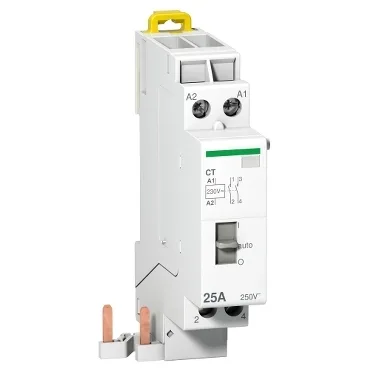
It clips onto a 35 mm symmetrical DIN rail and is rated for 25 A in AC-7A duty (resistive loads like lighting) and 8.5 A in AC-7B duty (inductive loads like small motors). The coil pulls 230 V AC at 50 Hz, with an inrush of 15 VA and a holding power of 3 W at 250 V AC. The 2 NO pole composition means both poles are normally open — it makes the circuit when the coil is energised. That fits standard control schemes where the contactor isolates the load until commanded. The maintained control signal type means it stays latched as long as coil voltage is present; no pulse or self-latching logic required.
The 18 mm width (one modular pitch) and 90 mm height let it sit neatly in a DIN-rail enclosure alongside other Acti9 devices. Two 9 mm pitches on the housing align with standard busbar systems for power distribution. The clip-on mounting means no tools for rail attachment — push on, pull off with a screwdriver tab. Terminals are tunnel type: power circuit accepts up to 2 x 2.5 mm² flexible or 1 x 6 mm² rigid; control circuit accepts 2 x 2.5 mm² flexible or 2 x 1.5 mm² rigid. Strip length is 10 mm, tightening torque 0.8 N·m.
The utilisation category AC-1 per IEC 60947-4 covers resistive loads — heaters, incandescent lighting, non-inductive banks — up to the full 25 A. For motor or inductive loads (AC-7B), the rated operational current drops to 8.5 A. That's the figure to use when sizing for a small fan or pump contactor; the AC-1 number is only for purely resistive circuits. Pollution degree 2 (non-conductive dust, occasional condensation) is typical for enclosed panels. The 2000 m operating altitude covers most installations; above that, derating applies per IEC standards. Mechanical durability is 200,000 cycles — the contactor is rated for that many operations before mechanical wear is expected. Switching frequency is 100 operations per day, which matches the on-load factor of 100 % (continuous duty, 86400 s). That means it can stay energised indefinitely without overheating, as long as the load stays within the rated current.