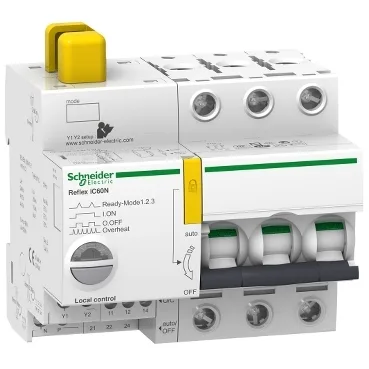
The 20 kA breaking capacity at 230 V AC (10 kA at 380–415 V) means it can safely interrupt a serious fault without upstream devices having to clear it. The control circuit accepts 230 V AC, 24 V AC, 48 V AC, 24 V DC, or 48 V DC, and supports maintained, impulse, or toggle commands. That's the flexibility you need when tying into a PLC output or a manual pushbutton station — no extra interface relay required for most common signal levels.
Takes 11 x 9 mm pitches of rail space — call it 99 mm wide, 84 mm tall, 77 mm deep. That's a standard 3-module footprint for the Acti9 family, so it slots into a distribution board without surprises. IP20 rated, so it's for inside an enclosure, not on the wet side of the panel door. The tropicalisation class 2 adds some margin for high-humidity storage or operation — 93% RH at 40 °C is the listed limit.
The B curve means the magnetic trip threshold is 3–5 times rated current (120–200 A for this 40 A unit). That's the standard choice for general distribution and control circuits — it won't false-trip on motor inrush, but it clears fast on a hard short. The thermal-magnetic trip technology is the workhorse for this class; no electronics to fail, no auxiliary power needed for the protection function. Electrical durability is 50,000 cycles under AC-1 resistive load at 50 Hz. That's the same as the mechanical endurance, so the switch mechanism is the limiting factor, not the contacts. For a control breaker that sees daily remote switching, that's a solid service life before you'd plan a replacement.