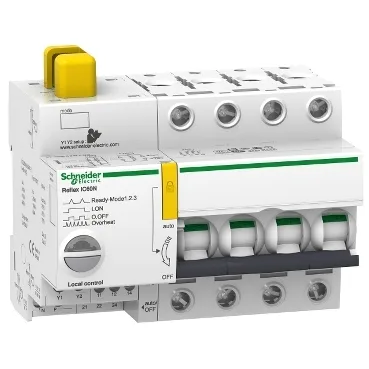
It combines overcurrent protection (MCB function) with local and remote switching control in a single 4-pole unit rated at 16 A with a C trip curve. The thermal-magnetic trip unit handles overloads and short-circuits, while the control section accepts multiple signal types: impulse (pulse), maintained (continuous command), and maintained very low voltage, all at 230 V AC, 24 V AC/DC, or 48 V AC/DC control voltages.
Breaking capacity is 20 kA Icu at 220...240 V AC and 10 kA Icu at 380...415 V AC, per EN/IEC 60947-2. At 16 A rated current, it fits a 16 A feeder or a group of loads summing to that figure. Electrical durability is 50,000 cycles under AC-1 (resistive) load at 50 Hz, with matching mechanical durability. That's a solid service life for a switching device that will see daily on/off cycles from remote commands or local toggle operation.
Control and integration
At 13 x 9 mm pitches (117 mm wide for 4 poles), it occupies four modular spaces. The fixed mounting mode means it stays put once snapped onto the rail. Control options include a local toggle ON/OFF button, remote control by pulse (impulse), remote control by continuous command (maintained), and a maintained very low voltage signal. This flexibility lets an integrator wire it for momentary pushbutton control from a PLC digital output, or for sustained signal from a safety relay or manual switch. Local signalling uses a multi-colour LED: green for ON, flashing for tripped or ready or overheat, red for fault. The contact position indicator gives a visual confirmation of the main contact state independent of the LED. IP20 protection means it's touch-safe but not sealed against moisture — standard for indoor panel installation. Earth-leakage protection requires a separate block (Vigi or similar), not integrated.