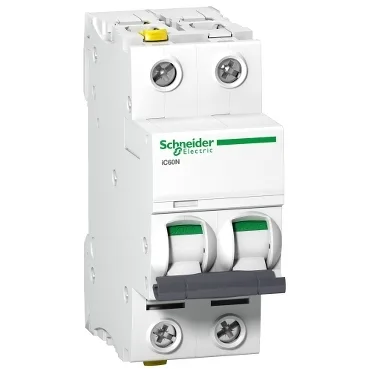
The 2-pole (2P) configuration switches both line and neutral, giving full isolation on single-phase AC or DC circuits. Breaking capacity is the headline number here: 50 kA Icu at 220-240 V AC (per EN/IEC 60947-2) means this breaker can safely interrupt a fault current up to 50,000 A without welding its contacts or failing catastrophically. At 400 V AC the Icu drops to 25 kA, and under the domestic standard EN/IEC 60898-1 it's rated 6 kA Icn at 400 V — so for a commercial or industrial panel fed by a transformer with high prospective fault current, the 60947-2 rating is the one that governs coordination. Thermal-magnetic trip technology combines a bimetal strip for overload protection (time-delayed, inversely proportional to current) and a solenoid for short-circuit protection (instantaneous above the magnetic threshold).
Width is 36 mm (4 x 9 mm pitches), height 91 mm, depth 78.5 mm — fits a standard distribution board or sub-panel enclosure. The double-terminal design (top or bottom) allows daisy-chaining or looping the supply without additional distribution blocks. Local trip indicator and contact position indicator give visual confirmation of state without needing to meter the load side — useful during commissioning or fault-finding when the panel door is open.
Dual-rated to EN/IEC 60947-2 (industrial) and EN/IEC 60898-1 (domestic/similar) — this gives flexibility in specification: the same breaker can be used in a residential consumer unit (60898-1) or an industrial panel (60947-2), with the higher breaking capacity of the latter standard governing the fault rating. Relative humidity tolerance is 95 % at 55 °C. Suitability for isolation is confirmed under both standards — the breaker can be used as a disconnecting means for safe maintenance, provided the load side is de-energised and the toggle is padlockable (check the specific padlock accessory for this frame).