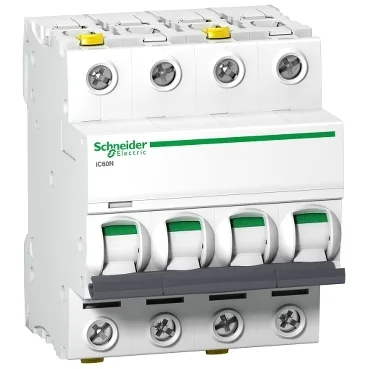
The Schneider Electric A9F05406 is an Acti9 iC60N miniature circuit breaker (MCB) with a D tripping curve, rated 6 A across 4 protected poles. The D curve's magnetic trip threshold of 12 x In ±20 % means it tolerates short-duration surges up to roughly 72 A before the solenoid fires, while still clearing a hard fault within the rated breaking capacity. This is a thermal-magnetic breaker, so the bimetal strip handles sustained overloads (the 6 A continuous rating) and the magnetic coil handles short-circuits. It is dual-rated to both EN/IEC 60947-2 (industrial) and EN/IEC 60898-1 (domestic / commercial), which is the standard split for a part that might sit in a panel feeding a motor starter or a distribution board feeding lighting and sockets. The utilisation category is A per EN/IEC 60947-2, meaning it is not intended for frequent switching of loads — it is a protection device, not a switch.
The A9F05406 carries a breaking capacity that varies by voltage, which is typical for an MCB rated under both standards. At 12-133 V AC it can interrupt 36 kA (Icu per EN/IEC 60947-2); at 220-240 V AC that drops to 20 kA; at 380-415 V AC it is 10 kA; and at 440 V AC it is 6 kA. The limitation class is 3 per EN/IEC 60898-1, which means it lets through less energy than a class 1 or 2 device — important for downstream equipment protection and for coordinating with a downstream sub-distribution board. For a panel OEM or site engineer, the relevant figure is the one at your system voltage. If your supply transformer can deliver 25 kA at 240 V, this breaker covers it. If you are on a 400 V industrial bus with a prospective fault current of 15 kA, the 10 kA rating at 380-415 V is the limit — you would need a higher-rated device or a current-limiting upstream fuse. The overvoltage category is IV, so it is rated for the main distribution board, not just a sub-panel.
The 4-pole body takes 8 x 9 mm pitches of rail space — 72 mm wide. Depth is 78.5 mm, height 91 mm. IP20 rated, so it is for inside an enclosure, not for wet locations. The toggle is the control type, and there is a trip indicator for local signalling — useful when you are walking a panel and want to see which breaker tripped without metering.