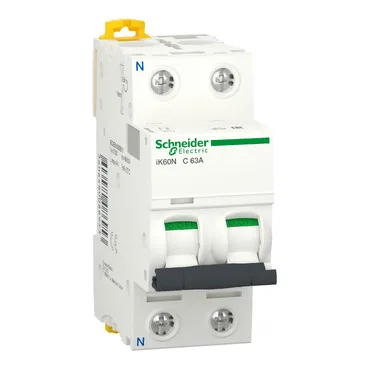
This is a 1P+N (single-pole protected, switched neutral) configuration — the phase pole has the thermal-magnetic trip, and the neutral pole switches but doesn't protect. The neutral sits on the left side of the unit. That matters when you're wiring a single-phase final subcircuit where you need to isolate both conductors but only protect the line. That's a compact footprint for a 63 A 1P+N unit; you can fit about 8 of these per foot of DIN rail in a distribution board. The tunnel-type terminals accept up to 35 mm² rigid or 25 mm² flexible, with a recommended tightening torque of 3.5 N.m and a strip length of 14 mm. Terminal capacity that generous for the 63 A rating means you can land larger incoming cables without needing an adapter or reducing the conductor.
It's certified to EN/IEC 60898-1, which is the harmonized European standard for MCBs used in household and similar installations. The limitation class 3 rating means it limits the let-through energy (I²t) to a level that protects downstream equipment better than a class 1 or 2 device — useful when you're coordinating with sensitive loads or trying to achieve selectivity with an upstream breaker.
Where it's used and how it fits
This MCB goes into a DIN-rail enclosure — typically a consumer unit, distribution board, or sub-distribution panel in a commercial building, small workshop, or residential installation. It's a distribution device (per the application field), meaning it's the downstream protection for lighting, socket circuits, and small loads, not the main incoming breaker. Rated insulation voltage is 440 V AC, so it's fine on a 230/400 V three-phase system when used on a single-phase leg. The IP20 protection means it's touch-safe but not splash-proof — install it inside a panel, not out in the weather.