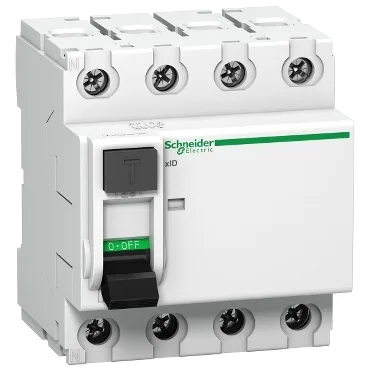
The Schneider Electric A9N16252 is a 4-pole residual current circuit breaker (RCCB) from the Acti9 xID range, rated 25 A with a 300 mA Type AC earth-leakage sensitivity. It operates on a 400…415 V AC 50 Hz network and clips onto a DIN rail for panel integration. The instantaneous trip response (no intentional delay) means it clears ground faults as they happen — no coordination window for nuisance tripping on inrush, but also no selectivity with downstream RCCDs of the same type.
The 25 A rated current (In) and 300 mA sensitivity define the load and protection boundary. For a 4-pole RCCB on a 400 V three-phase system, 25 A covers typical sub-distribution or lighting circuits — not a main incoming breaker. The Type AC classification means it detects sinusoidal AC earth-leakage only; pulsed DC or smooth DC faults (from VFDs, UPS, or rectified loads) will pass through undetected. If the downstream load includes any power electronics, you need a Type A or Type B RCCB instead. Breaking capacity is 500 A per IEC 61008-1. In a panel with an upstream MCB, the RCCB relies on the MCB to clear high faults. Insulation voltage (Ui) is 500 V AC, and operational voltage (Ue) is 400…415 V AC. The 50 Hz network frequency is fixed.
The 4-pole body occupies 8 modules of 9 mm pitch (72 mm total width). Neutral is on the left. Tunnel terminals accept 1…35 mm² rigid or 1…25 mm² flexible — strip 14 mm, torque to 3.5 N·m. The 18 mm phase-to-phase pitch matches standard busbar systems in Acti9 distribution boards. IP20 finger-safe terminals are fine inside an enclosed panel. The white body with toggle control and local signalling (ON, OFF, fault trip) gives clear visual status. A padlocking device is available for lockout/tagout.