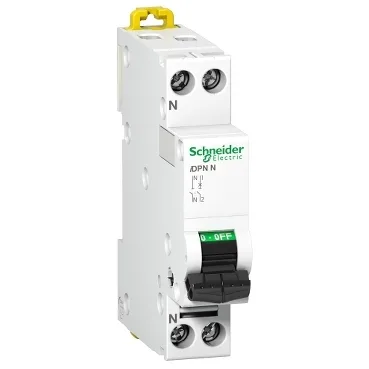
It protects a single pole (phase) and switches the neutral, all in an 18 mm wide, clip-on DIN rail footprint. The thermal-magnetic trip unit gives you the standard two-stage protection: thermal overload on sustained overcurrent, magnetic instant trip on short-circuit. It's a workhorse MCB, not a specialty device — the sort you'd reach for when the BOM calls for a 13 A single-pole breaker and you need it to fit a standard DIN-rail enclosure.
For a panel with multiple breakers ganged together, you'll want to derate per the manufacturer's thermal table — standard practice in a crowded enclosure. That's fast enough to clear a hard short before the downstream wiring takes damage, but it won't nuisance-trip on the small inrush of a few LED drivers or a contactor coil. If your load has a motor start or transformer inrush, you'd want a Curve C or D — this one's for the predictable, low-surge branch. For most final sub-circuits in a TN or TT system, 6 kA is the standard floor. The 1P+N configuration switches the phase and disconnects the neutral, but the neutral pole is not protected — it's a switched neutral, not a second protected pole. That's typical for single-phase final circuits where the neutral is bonded at the source. The neutral sits on the left side of the breaker, which matters for busbar alignment in a split-bus panel.
That's one module wide — tight for a 1P+N in some older ranges, but standard for the iDPN N family. The 78 mm depth leaves room in a shallow enclosure; you're not fighting gland-plate clearance. Tunnel-type terminals accept 0.75 to 16 mm² rigid or 0.33 to 10 mm² flexible upstream and downstream. IP20 finger protection on the front — standard for a panel-mounted device.
Operating altitude rated to 2000 m without derating. Above that, the air's lower dielectric strength reduces the breaker's interrupting capacity — standard practice to derate 1% per 100 m above 2000 m if you're installing at altitude. Electrical and mechanical durability both rated at 20,000 cycles. That's the standard endurance for an MCB in distribution duty — not a frequent-switching device like a contactor, but fine for the occasional manual isolation or fault clearance it will see in its service life.