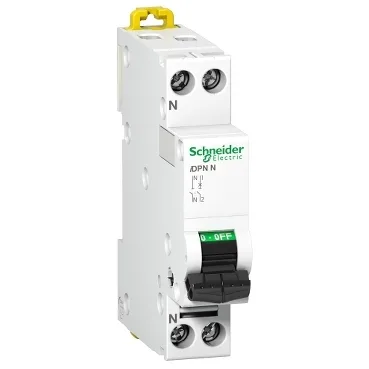
The B curve means magnetic tripping occurs at 3 to 5 times the rated current (60 to 100 A) — designed for resistive or lighting loads with low inrush, not motor starting. The 6 kA breaking capacity at 230 V AC (Icn per EN/IEC 60898-1) tells you it can safely interrupt a fault current up to 6,000 A without welding contacts or cascading failure upstream. That is the standard domestic and light commercial fault level; for higher prospective short-circuit currents you would step to a 10 kA or 15 kA rated breaker. The thermal-magnetic trip unit combines a bimetal strip for overload protection (slow response to sustained overcurrent) with a solenoid for short-circuit protection (instantaneous on high fault). This is the standard dual-action mechanism for MCBs; no electronic adjustment here — you select the rating and curve, and it is fixed. The 1P+N configuration switches the line conductor only; the neutral is switched but not protected. The neutral pole opens and closes with the line pole, providing isolation on both conductors when the toggle is off.
The 18 mm width per pole (2 x 9 mm pitches) means this 1P+N unit occupies two modules — 18 mm total. Plan your DIN rail fill accordingly; a standard 12-module enclosure holds six of these breakers side by side. Tunnel-type terminals accept 0.75 to 16 mm² rigid or 0.33 to 10 mm² flexible cable. The neutral terminal is on the left side of the unit.