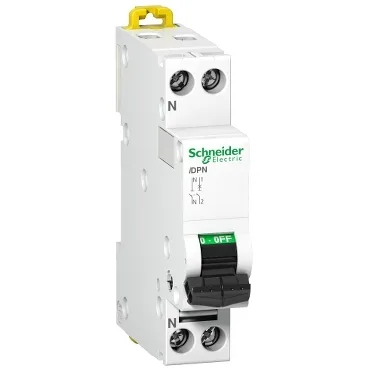
It breaks fault currents up to 4500 A Icn at 230 V AC (50/60 Hz) per EN/IEC 60898-1.
The B curve (magnetic trip at 3...5 x In) means it trips instantaneously between 120 A and 200 A. That's the standard choice for resistive loads and general-purpose socket circuits where inrush is low — lighting, heaters, small office outlets. If you're protecting motor circuits or transformers with higher inrush, a C or D curve would be the better pick; this one will nuisance-trip on those loads. The 1P+N configuration switches the phase and provides a switched neutral that opens with the phase. That's common in single-phase final circuits where you want the neutral isolated when the breaker is off — typical in UK and European distribution boards. Thermal-magnetic trip technology covers both overload (thermal bimetal, slower response) and short-circuit (magnetic coil, instantaneous). IP20 finger-safe terminals are fine for enclosed boards; not rated for wet or dusty environments.
Integration notes
Tunnel-type terminals accept 0.75...16 mm² rigid or 0.33...10 mm² flexible on both line and load sides. Strip length 13 mm. That's enough for a 6 mm² feed into a 40 A circuit — typical for a cooker or shower circuit in domestic boards. Mechanical durability is 20000 cycles, electrical durability 10000 cycles — that's the rated number of on/off operations under load before wear-out. Fine for a distribution board that sees infrequent switching; not a switch-disconnector for daily operation. Suitable for isolation (marked with the isolation symbol on the device), so it can be used as a disconnecting means for the downstream circuit during maintenance, provided the supply side is de-energised or the breaker is off and locked out.