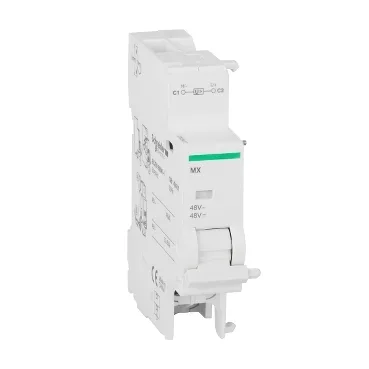
It sits downstream of the breaker's trip mechanism; when you apply 48 V AC or DC to its control circuit, it mechanically trips the host breaker, giving you a remote emergency-stop or interlock function without running power wiring through the breaker itself. The control circuit draws its power from a separate source, not the breaker's load path. Mounts on a 35 mm symmetrical DIN rail, occupies 18 mm of panel width (one modular pitch), and the depth is 73.5 mm — standard for the Acti9 accessory footprint. The white housing carries a mechanical action indicator so you can see the trip state at a glance.
Lifecycle reality — obsolete, not gone
No official Schneider successor order code exists for this shunt trip variant.
The 48 V control voltage is the key fit parameter — it must match your trip-signal source. The part works on both AC and DC at that same voltage, which simplifies wiring in mixed-supply panels. The 18 mm width means it takes one standard DIN-rail pitch; if your panel is tight, that's one less modular slot than a two-pitch accessory. EN/IEC 60947-2 is the standard for low-voltage switchgear and controlgear — specifically the section covering circuit-breaker accessories. That certification tells you the shunt trip has been type-tested for coordination with the host breaker, so you don't lose selectivity or breaking capacity when you add it. The bottom screw-clamp terminals accept 0.5 to 2.5 mm² rigid or 1.5 mm² flexible (with or without ferrule), with a stripping length of 9 mm and a tightening torque of 1 N·m. That's standard for control wiring in a panel — no special tooling needed.