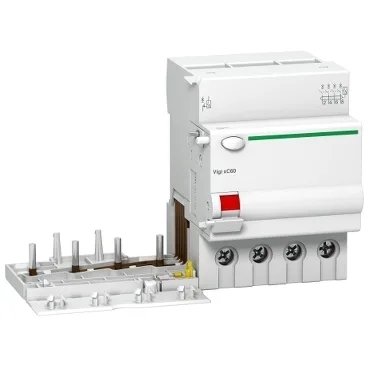
The Schneider Electric A9N26644 is a Vigi xC60 add-on residual current device (RCD) from the Acti9 range, designed to clip onto the outgoing side of a compatible MCB or RCBO. It adds earth-leakage protection to an existing circuit breaker without replacing the whole device — a clean way to retrofit ground-fault protection into a panel that already has standard overcurrent protection. Rated at 63 A with 100 mA sensitivity, Type AC (sinusoidal AC residual currents only), it handles the common residential and light-commercial loads where the leakage path is purely sinusoidal. The 4-pole version (4P) suits three-phase outgoers, with the neutral pole switched as well. The voltage-independent electromechanical trip means it clears a fault even if the neutral is lost upstream — no electronics to starve.
The 63 A rated current (In) matches the upstream MCB's rating; you pair this RCD with a 63 A breaker on the same outgoing circuit. The 100 mA sensitivity is less sensitive than the common 30 mA for personal shock protection — it is sized for equipment protection or for circuits where a 30 mA device would nuisance-trip (e.g., long cable runs with natural leakage). If the load includes rectifiers, VFDs, or switched-mode supplies that generate pulsed DC or high-frequency leakage, you need Type A or Type B instead. For purely resistive or induction-motor loads with no electronic front end, Type AC is sufficient and costs less. The instantaneous trip (no intentional delay) clears a fault within tens of milliseconds. That is fine for most circuits but may cause coordination issues if you have downstream RCDs — you would need a time-delayed (S-type) device upstream to avoid simultaneous tripping. Insulation voltage is 500 V AC, and impulse withstand is 6 kV — enough for typical distribution panels without additional surge protection.
Clip-on mounting onto a DIN rail — no tools needed for the rail itself. Strip length 14 mm. Electrical connection to the upstream MCB is by screws (the add-on block bolts directly to the breaker's outgoing terminals). The red indicator on the front face shows when the RCD has tripped — useful for troubleshooting a downstream fault without metering. IP20 on the body (finger-safe), IP40 inside the modular enclosure — standard for indoor distribution boards.