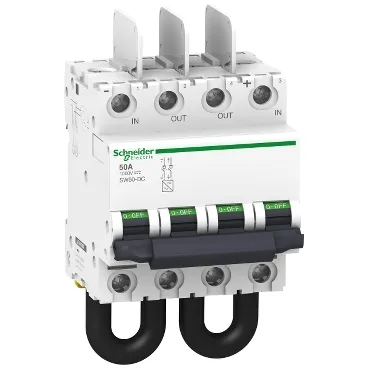
The rating that matters — 50 A at 1000 V DC
The headline number is 50 A rated operational current in DC-21A utilisation category at 1000 V DC and 40 °C ambient. DC-21A covers resistive and lightly inductive loads — think heater banks, not motor drives — so this switch is sized for the DC bus of a solar combiner box or battery string. The rating derates with temperature: at 70 °C it's still good for 35 A DC-21A, while at 5 °C it handles 63 A. That temperature curve is printed on the datasheet because a hot rooftop inverter cabinet pulls the rating down; spec it for the worst-case ambient, not the nameplate.
Isolation and safety
It's certified as a switch disconnector suitable for isolation per EN/IEC 60947-3, with a rated impulse withstand voltage of 6 kV and pollution degree 2. That means it provides visible air-gap isolation when toggled off — no hidden leakage path. Polarity sensitivity is marked: + and - must be respected on connection, so it's not a general-purpose DC breaker you can wire backwards. The voltage drop across the contacts at 50 A is 251 mV (5.02 mOhm, 12.54 W dissipation), which is low enough to avoid thermal trouble in a well-ventilated enclosure.
That means it's still a standard catalog item from Schneider, not a surplus scavenge. If you're freezing a BOM for a solar installation, this part is a safe line item.
That's typical for a disconnect switch — it's not a daily-operating contactor. Tightening torque on the terminals is 3.5 N.m, which is firm but achievable with a standard screwdriver. The 9 mm pitch across 8 positions gives you clear wiring lanes for the DC cables.