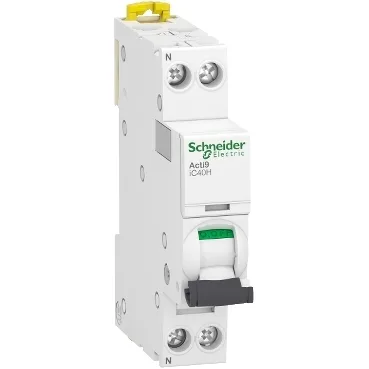
The Schneider Electric A9P55616 is a miniature circuit-breaker from the Acti9 iC40H range. It's rated for a breaking capacity of 10,000 A Icn at 230 V AC, 50/60 Hz, conforming to EN/IEC 60898-1. The limitation class is 3 per the same standard, which means it lets through less fault energy than a Class 1 or 2 breaker, so downstream equipment sees a milder stress during a short. The device is a single module wide (18 mm per pole, so 2 modules for the 1P+N), clips onto a DIN rail, and has tunnel-type terminals that accept up to 16 mm² rigid or 10 mm² flexible copper. The IP20 body is fine for a dry indoor panel; the IP40 modular enclosure rating means it's a bit more protected once installed inside a distribution board.
The C-curve (5-10 x In) is the default for most general-purpose circuits — lighting, receptacles, small motors, control transformers. If your load has a high inrush (like a large motor or a bank of fluorescent ballasts), you'd want a D-curve; if it's purely resistive, a B-curve might do. But for a standard 16 A lighting or general-purpose branch, this is the right curve. The 1P+N configuration means it switches the phase and provides switched neutral isolation, but the neutral pole is not protected — only the phase pole has the thermal-magnetic trip. That's typical for single-phase final circuits in many European distribution boards. The neutral position is left, so it's keyed for the busbar arrangement in Acti9 boards. The electrical and mechanical durability are both rated at 20,000 cycles. That's the standard endurance for a domestic MCB — it'll handle years of normal switching and occasional fault interruptions without wearing out the mechanism. The contact position indicator and the ON/OFF and trip indicator give you a visual check without needing to open the panel door.
It carries a VDE quality label, which is the German safety mark and is widely recognized across Europe. The pollution degree is 3, meaning it's suitable for environments with conductive or dry non-conductive pollution — typical for an indoor distribution board that isn't sealed. The operating altitude is rated to 2,000 m without derating.