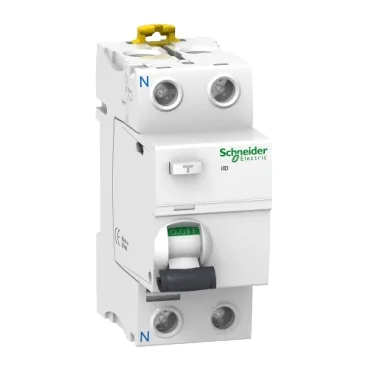
The Schneider Electric A9R11225 is an Acti9 iID residual current circuit breaker (RCCB) — a 2-pole, Type AC device rated for 25 A continuous load with 30 mA earth-leakage sensitivity.
The 30 mA sensitivity is the standard threshold for personal protection against indirect contact in residential and commercial final circuits — it trips on leakage currents above that level, not on overload or short-circuit (that's the MCB's job upstream). The 25 A rated current (In) matches a 25 A MCB in the same distribution board for a coordinated outgoing circuit. For variable-speed drives, UPS outputs, or LED drivers with rectifier stages, a Type A or Type F RCCB would be required instead. In a domestic or light commercial panel with a typical prospective short-circuit current under 1500 A, it's adequate; for industrial boards with higher fault levels, verify the upstream protection limits the let-through. Voltage-independent tripping means the RCCB will still open on an earth fault even if the phase voltage collapses — the trip energy comes from the fault itself, not the supply. This is standard for electromechanical RCCBs and gives reliable protection regardless of supply conditions. The 8/20 µs impulse withstand of 250 A means it survives common lightning-induced surge currents without nuisance tripping — important for outdoor-fed circuits or areas with frequent storms.
This outgoer device sits downstream of the main switch or incoming MCB, protecting a final sub-circuit. The 2-pole (2P) configuration switches both phase and neutral. Clip-on mounting to a 36 mm wide DIN-rail footprint (4 x 9 mm pitches) means it snaps directly into a standard distribution board alongside Acti9 MCBs and other modular devices. The white housing matches the Acti9 family aesthetic for clean panel layouts. Terminals accept up to 35 mm² rigid or 25 mm² flexible cable — sufficient for a 25 A circuit with typical 4 mm² or 6 mm² final sub-main wiring. Torque to 3.5 N·m. Strip length is 14 mm.
It carries EN/IEC 61008-1 certification, which is the harmonized European standard for RCCBs. This is the compliance basis for CE marking and acceptance in most countries that follow IEC wiring rules. No UL listing — this is an IEC-market device, not intended for North American panels.