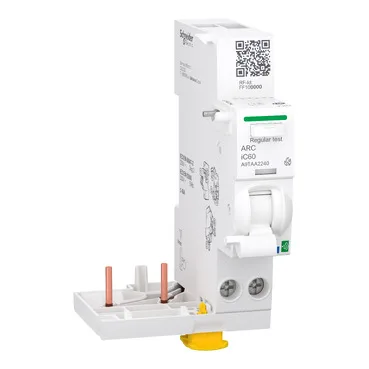
The Schneider Electric A9TAA2240 is an Acti9 ARC iC60 active arc fault detection add-on block — a 2-pole, 40 A device that clips onto the side of an iC60 MCB to add series arc-fault protection per EN/IEC 62606. The 73 mm depth and 54 mm width keep it within the standard Acti9 footprint, so it swaps in without re-spacing the rail.
It trips the MCB when the arc energy exceeds the threshold defined in EN/IEC 62606, which covers both series and parallel arcs. The 275 V ±5 V trip threshold for overvoltage detection means it catches a sustained line-to-neutral swell before the arc reaches full fault current — a layer of protection a standard MCB alone doesn't provide. Accuracy on power measurement is ±5 %, good enough for energy logging but not precision metering. Electrical durability is rated at 10,000 cycles under load at 230 V AC per IEC 62606; mechanical durability is 20,000 cycles. That's the standard endurance for a residential-grade AFDD — it's not a motor-starting switch, but it's well matched to the switching frequency of a final-distribution board.
Clip-on mounting to the iC60 MCB means the assembly is one DIN-rail unit — no extra wiring between the block and the breaker beyond the screw connection. The tunnel terminals accept 1–10 mm² flexible or 1–16 mm² rigid, with a wire-strip length of 14 mm and a tightening torque of 2 N·m. IP20 rated, so it's for indoor panel use only; the tropicalisation rating (severity B, 28 days per IEC 60068-2-30) covers high-humidity environments like coastal or unconditioned electrical rooms. It communicates event data — overvoltage, earth leakage, overload, and arc fault diagnostics — to EcoStruxure Panel Server concentrators (Advanced, Entry, or Universal) for remote monitoring. The local LED signals ON, OFF, fault trip, and arc fault diagnostic, so a field tech can read the last trip cause without a tool.