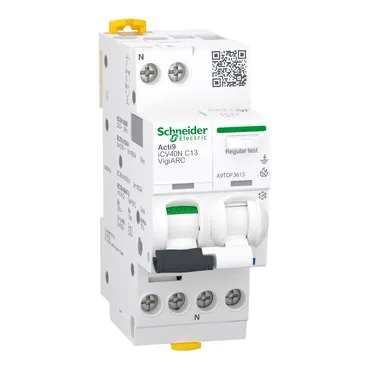
Arc-fault RCBO for final-circuit protection
The 1P+N pole configuration switches the line and monitors the neutral, with the neutral position on the left side of the unit. Breaking capacity is 6 kA Icn per EN/IEC 61009-2-1 and 10 kA Icu per EN/IEC 60947-2 at 230 V AC, placing it in breaking capacity code N. The thermal-magnetic trip unit handles the overcurrent side; the arc-fault electronics detect hazardous arcing patterns and trip the internal mechanism, with a local signalling LED indicating ON, OFF, or fault-trip status. The white (RAL 9003) housing carries IP20 finger protection per IEC 60529, suitable for enclosed distribution boards.
The 6 kA Icn is the rated short-circuit capacity per the product standard (EN/IEC 61009-2-1); the 10 kA Icu is the ultimate breaking capacity per the industrial standard (EN/IEC 60947-2), meaning the device can interrupt a 10 kA fault once and remain functional, though it may need replacement after such an event. Limitation class 3 means the device limits the let-through energy (I²t) and peak current during a short-circuit, reducing stress on downstream wiring and connected equipment. This is a practical advantage when coordinating with downstream MCBs or protecting sensitive loads. The arc-fault detection function complies with EN/IEC 62606, the standard for AFDDs. It monitors the waveform for characteristic signatures of series arcs (e.g., a loose connection in a junction box) and parallel arcs (e.g., a damaged cable between phase and neutral). The device trips within the time limits defined by the standard, adding a layer of fire-safety protection that a standard RCBO alone cannot provide.
Installation and wiring notes
Cable entry is from top or bottom, giving flexibility in busbar or cable routing within the distribution board. The device is tropicalised to severity B per IEC 60068-2-30 for 28 days, meaning it withstands cyclic humidity and temperature exposure typical of tropical climates. Total power losses are 3.255 W (2.75 W per pole), which matters for thermal management inside a sealed enclosure with multiple devices ganged together.