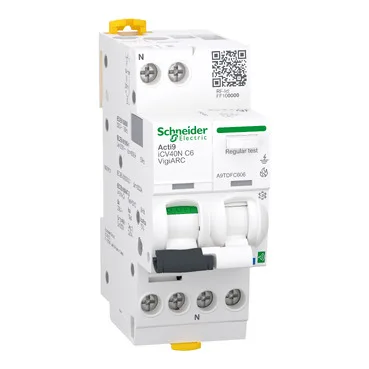
The 6 kA Icn is the service breaking capacity per EN/IEC 61009-2-1; the 10 kA Icu per EN/IEC 60947-2 is the ultimate breaking capacity, giving headroom for fault currents up to 10 kA at 230 V AC. The thermal-magnetic trip unit handles overloads via a bimetal strip and short-circuits via a solenoid — no electronics to fail in the trip path. The arc-fault detection adds series arc monitoring per EN/IEC 62606, which means it can distinguish a dangerous arc (loose connection, damaged cable) from normal switching arcs. That's the main value over a standard RCBO: it catches faults a thermal-magnetic alone misses. Accuracy for the measurement functions is ±2 % for voltage and current, ±5 % for power — good enough for energy monitoring and fault logging, not for revenue-grade metering. The local signalling includes an LED for arc-fault diagnostics, so a maintenance tech can tell at a glance whether the trip was from an arc event or a conventional overload/earth leakage.
Deployment context
Cable entry from top and bottom gives flexibility in busbar or wired layouts. The tropicalisation rating — severity B per IEC 60068-2-30 for 28 days — means it handles high-humidity storage and operation, which matters for sites in coastal or tropical climates.