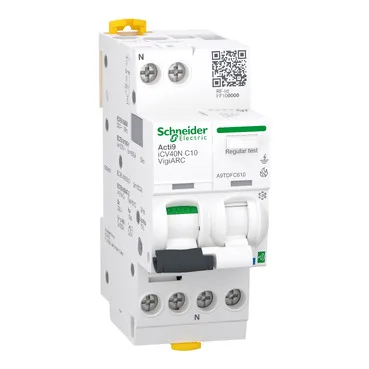
It packs three protection functions into one DIN-rail unit: arc-fault detection per EN/IEC 62606, earth-leakage protection, and thermal-magnetic overcurrent protection (C curve, 10 A rated). For the panel builder, that means one clip-on device covers arc-fault, ground-fault, and branch-circuit overcurrent — no separate AFCI module needed, saving two DIN spaces. Breaking capacity: 6 kA Icn at 230 V AC per EN/IEC 61009-2-1 (the RCBO standard), and 10 kA Icu per EN/IEC 60947-2 (the MCCB standard). Measurement accuracy: ±2 % on voltage and current, ±5 % on active power and power factor. That's metering-grade — good enough for energy monitoring and load profiling on a branch circuit, not utility-billing accuracy. The device reports these values locally via the arc-fault diagnostic LED and toggle position, not over a bus.
Clip-on DIN rail mount, 36 mm wide (4 x 9 mm pitches), 73 mm deep. That 73 mm depth is tight in shallow enclosures — check your gland-plate clearance if the panel is under 80 mm useable depth. Rated for pollution degree 2, overvoltage category III, and tropicalisation severity B per IEC 60068-2-30 (28-day damp-heat cycle). That means it's fine in unconditioned enclosures, humid basements, or outdoors under a weatherproof housing — the 95 % RH at 55 °C limit covers most European and coastal installations.
Approvals and compliance paperwork
Carries IMQ, AENOR, and OVE quality labels — those are Italian, Spanish, and Austrian national marks, respectively. Standards compliance: EN/IEC 62606 (arc-fault detection), EN/IEC 61009-1 and -2-1 (RCBO), and EN/IEC 60947-2 (MCCB supplementary). For the quality-doc controller, that covers the European Low Voltage Directive via CE marking; no separate UL or CSA listing is on the record.