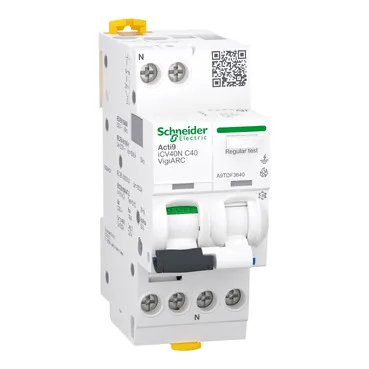
The Schneider Electric A9TDF3640 is an Acti9 iCV40 ARC residual-current circuit breaker with overcurrent protection (RCBO), rated 40 A, Curve C, 1P+N, for 230 V AC 50 Hz networks. It combines thermal-magnetic overcurrent protection with arc-fault detection (AFDD) per EN/IEC 62606, plus residual-current protection per EN/IEC 61009-1 and EN/IEC 61009-2-1, and meets the breaking-capacity requirements of EN/IEC 60947-2. The 6 kA Icn (EN/IEC 61009-2-1) and 10 kA Icu (EN/IEC 60947-2) at 230 V AC mean it can safely interrupt fault currents up to those levels without upstream cascading — the Icu figure is the ultimate short-circuit capacity the device can clear once and still be functional afterward, while Icn is the rated short-circuit capacity for the RCBO standard. That's a solid margin for most residential and light-commercial final circuits.
Clip-on mounting onto a DIN rail (EN 60715) — four 9 mm pitches wide (36 mm), so it takes up the same footprint as a standard 1P+N MCBO. Cable entry from top or bottom; tunnel terminals accept 1…16 mm² rigid or 1…10 mm² flexible, with a 2 N·m tightening torque and 14 mm strip length. The white (RAL 9003) housing is the standard Acti9 finish.
The 40 A rating and Curve C (magnetic trip 5…10 × In) make it suitable for general-purpose final circuits with moderate inrush — lighting, socket outlets, small appliances. The limitation class 3 (energy let-through) keeps downstream equipment damage low during a fault. The arc-fault detection (AFDD) per EN/IEC 62606 adds a layer of protection against series and parallel arcs that a standard RCBO wouldn't catch — useful for circuits where loose connections or damaged cables are a known risk. Tropicalisation severity B per IEC 60068-2-30 (28 days) means it's tested for high-humidity environments (95% RH at 55 °C) without condensation issues.