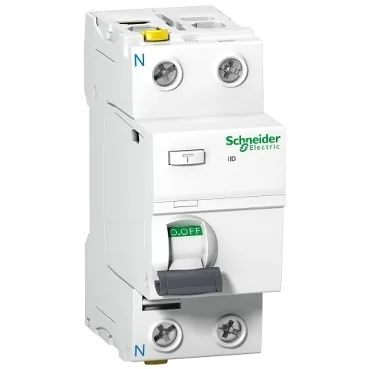
Rated 40 A continuous on a 220...240 V AC 50/60 Hz network, it trips on 100 mA residual current, Type A, covering sinusoidal AC and pulsating DC fault currents up to that threshold. That 100 mA sensitivity is a common spec for general distribution circuits where a lower 30 mA threshold isn't required by code — think submain feeders or lighting panels where nuisance tripping on leakage from long cable runs would be a problem.
Clip-on DIN rail mount, 4 module pitches wide (36 mm per pitch, so 144 mm total width). Neutral on the left, toggle control, IP20 on the body with IP40 inside a modular enclosure. That's enough for a 40 A feed conductor without a separate terminal block.
Current-production part per the manufacturer's lifecycle stage. The A9Z22240 is an active catalog item in the Acti9 range — no last-time-buy window, no successor to track. For a BOM freeze, this is a stable SKU with no imminent obsolescence risk.
Breaking and making capacity (Idm/Im) is 1500 A, which covers the typical prospective fault current at the device terminals in a subdistribution panel. Electrical durability is 15,000 cycles under AC-1 (resistive load), mechanical durability 20,000 cycles — that's a solid service life for a panel that sees regular switching. Impulse withstand voltage (Uimp) is 6 kV, insulation voltage (Ui) 500 V AC, so it's comfortable in 400 V three-phase panels even though the operational coil voltage is 240 V line-to-neutral. The 8/20 µs impulse withstand of 250 A means it survives surge events without nuisance tripping.
That's the compliance basis for CE marking in the EU and UKCA in Great Britain. The Type A classification covers sinusoidal AC and pulsating DC residual currents, which is the minimum requirement for most general-purpose and EV-charging circuits under IEC 60364.